"How to Build a High Load Backend From API Design to Load Distribution")
How to Build a High Load Backend: From API Design to Load Distribution
Modern applications are expected to support millions of users while maintaining high performance and reliability. Whether it is a SaaS platform, marketplace, or social product, backend systems must process large volumes of requests without slowing down or failing under pressure.
In practice, systems rarely break because of a single component. They fail because the entire backend was not designed to operate under load. API design, request handling, traffic control, and workload distribution all become critical once traffic starts growing.
Building a high load backend is not about adding more servers. It is about designing how requests flow through the system, how work is distributed, and how failures are handled.
API Design Under Load
Efficient Request Handling as a Foundation
API performance is directly tied to how each request is processed. Under high load, even small inefficiencies become system-wide bottlenecks. Excessive object creation, complex request processing, or unnecessary database calls increase latency and reduce throughput.
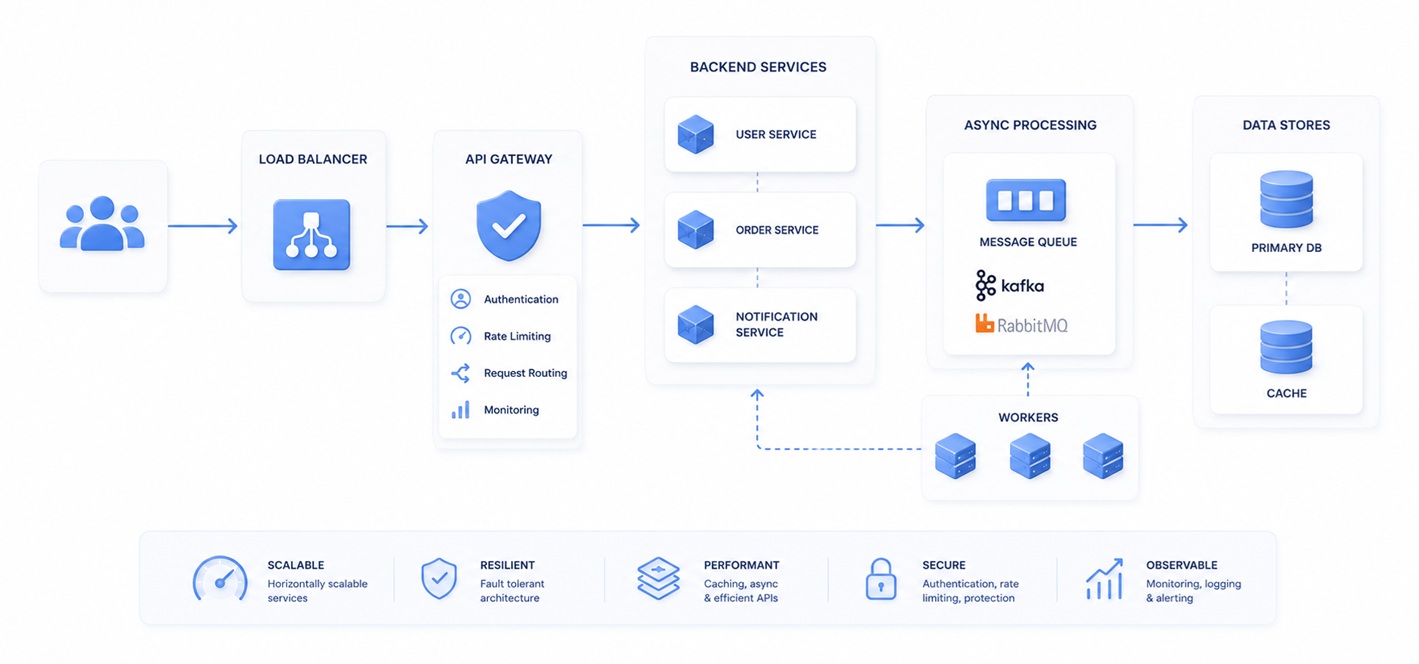 High-performance APIs are designed to minimize overhead in every request-response cycle. This means reducing payload size, avoiding redundant computation, and structuring endpoints so that each request does only what is strictly necessary.
In real systems, inefficient APIs do not fail immediately. They degrade gradually as traffic increases, eventually creating cascading delays across services.
Controlling Data Flow and Response Size
Large datasets and unbounded responses are one of the most common causes of backend instability. Pagination, batching, and filtering are not optional features. They are required mechanisms to prevent memory pressure and long response times.
At scale, API design becomes less about flexibility and more about predictability. Systems must behave consistently regardless of how many users are interacting with them.
Rate Limiting and Traffic Control
Protecting the System from Itself
As traffic grows, not all requests are equal. Some are legitimate, some are redundant, and some are harmful. Without control mechanisms, backend systems can be overwhelmed even by valid usage patterns.
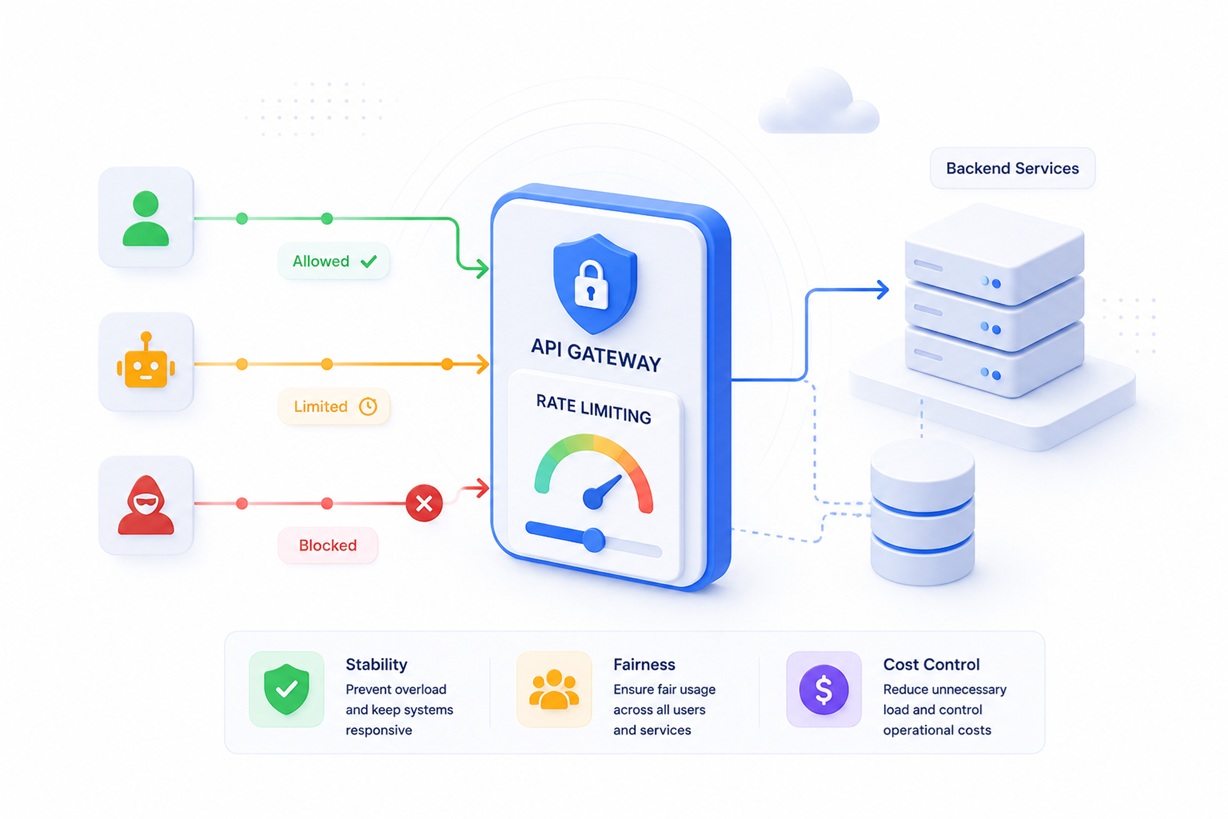
Rate limiting acts as a protective layer between clients and infrastructure. It ensures that no single user or service can consume disproportionate resources.
In high traffic systems, rate limiting is typically implemented at the API gateway level, where it can control request flow before it reaches core services.
Stability, Fairness, and Cost Control
Rate limiting is often seen as a defensive feature, but in reality it is also a business mechanism. It ensures fair usage across users, prevents infrastructure overload, and controls operational costs during traffic spikes.
Large platforms rely on this approach to maintain consistent performance even under unpredictable demand.
If you are planning to scale your product or expect traffic growth, it is critical to validate your backend architecture early before bottlenecks appear in production.
Start scaling with us!Asynchronous Processing and Workload Distribution
Why Synchronous Architectures Break
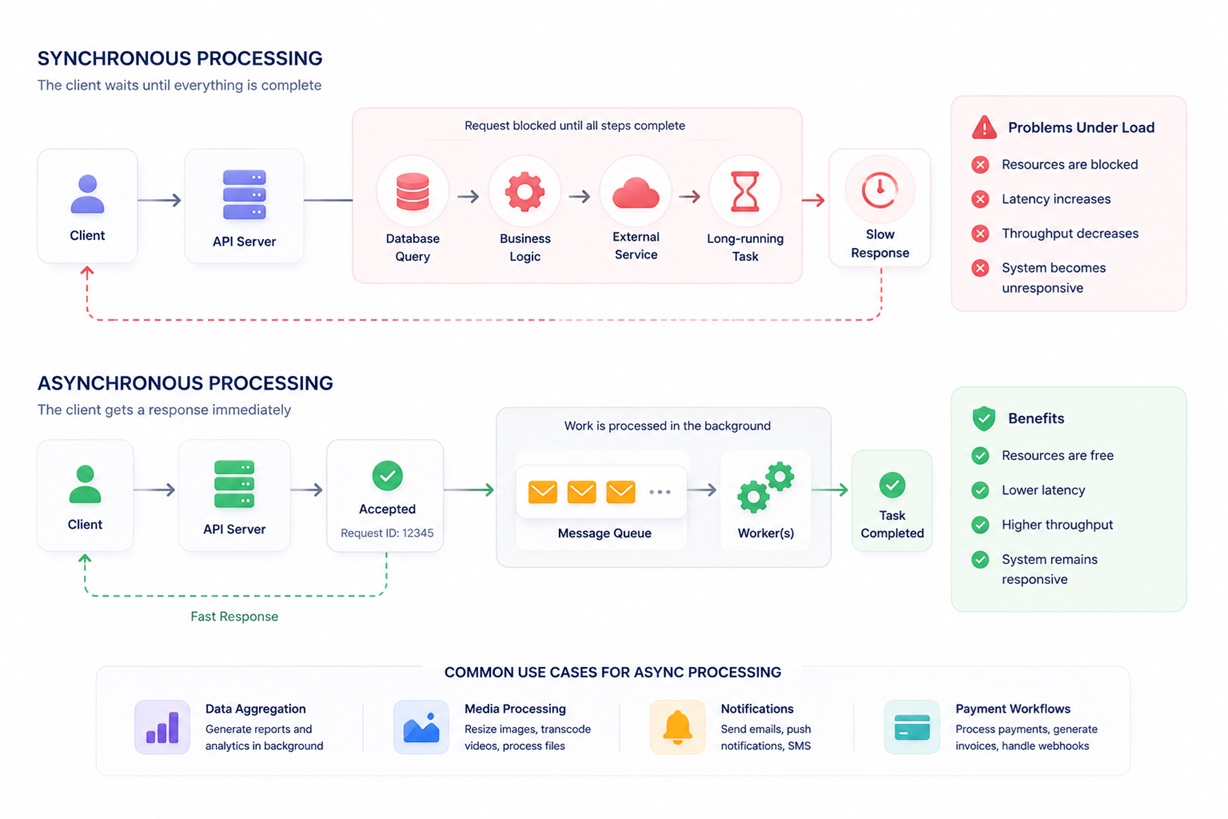
Synchronous systems handle requests in a linear way. A request arrives, processing starts, and the client waits until everything is complete. This model works at low scale but becomes inefficient under heavy load.
Long-running operations, I/O-heavy tasks, and external dependencies block system resources. As traffic increases, these delays accumulate and reduce system responsiveness.
Moving Work Outside the Request Cycle
Asynchronous processing changes this model by decoupling request handling from task execution. Instead of processing everything immediately, the system delegates heavy work to background workers.
This approach significantly improves throughput and reduces latency. APIs respond faster because they are no longer responsible for completing every operation in real time.
In practice, asynchronous processing is used for tasks such as data aggregation, media processing, notifications, and payment workflows.
Our team designs high load backend systems that remain stable under pressure and scale without unnecessary complexity or infrastructure waste.
Contact Binerals!Queues and Message Brokers: Kafka and RabbitMQ
Decoupling Services at Scale
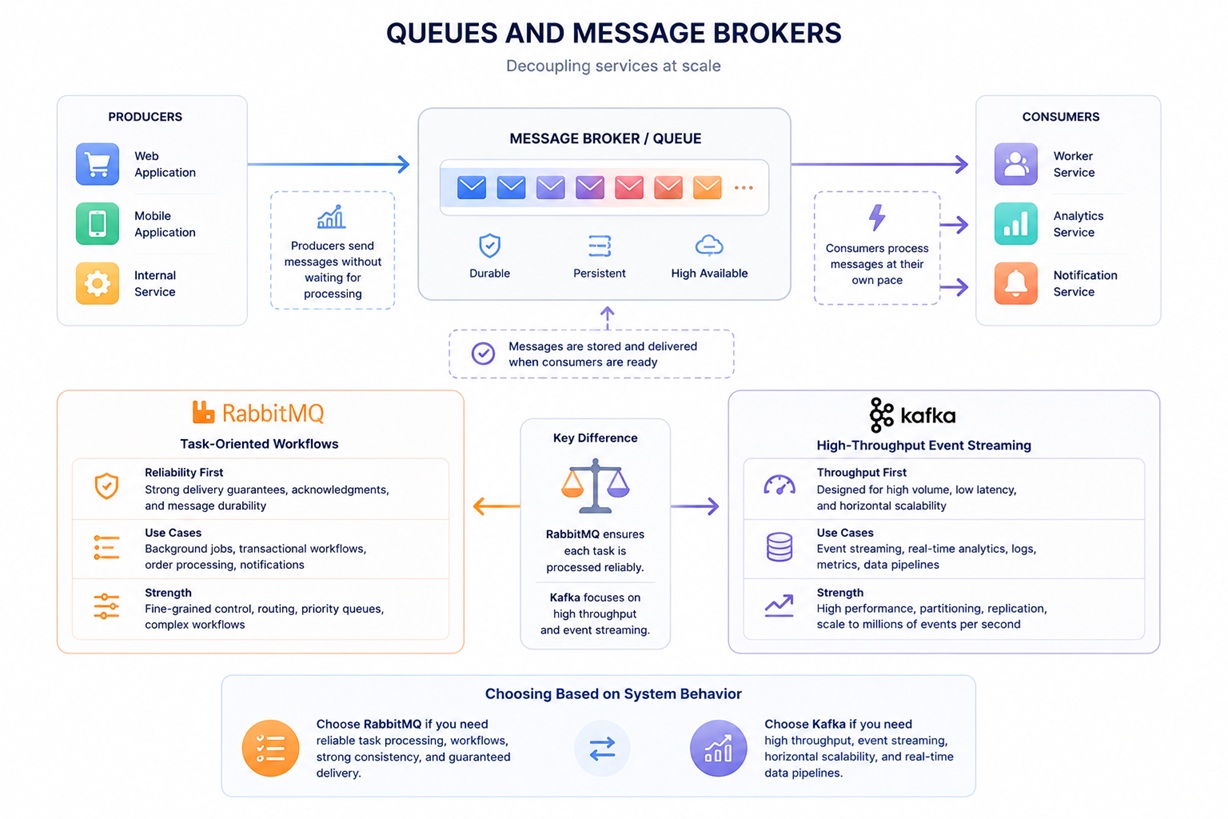
Queues are a fundamental component of high load systems because they separate producers from consumers. This means that one part of the system can generate work without waiting for another part to complete it.
This decoupling improves reliability and allows systems to handle spikes more gracefully.
RabbitMQ for Task-Oriented Workflows
RabbitMQ is commonly used in systems where reliability and message delivery guarantees are critical. It is well suited for background jobs, transactional workflows, and scenarios where tasks must be processed in a controlled and predictable way.
Kafka for High-Throughput Systems
Kafka is designed for high-volume event streaming and data pipelines. It is often used in systems that process large amounts of real-time data, such as analytics platforms or event-driven architectures.
Unlike traditional queues, Kafka is optimized for throughput and scalability rather than individual task reliability.
Choosing Based on System Behavior
The decision between Kafka and RabbitMQ is not about which tool is better. It depends on the type of workload. Task processing and workflow orchestration favor RabbitMQ, while streaming and large-scale event processing favor Kafka.
Book a technical consultation to identify weak points in your current backend and define a scalable architecture tailored to your growth stage.
Book a call today for free!Load Balancing and Traffic Distribution
The Entry Point of Every Scalable System
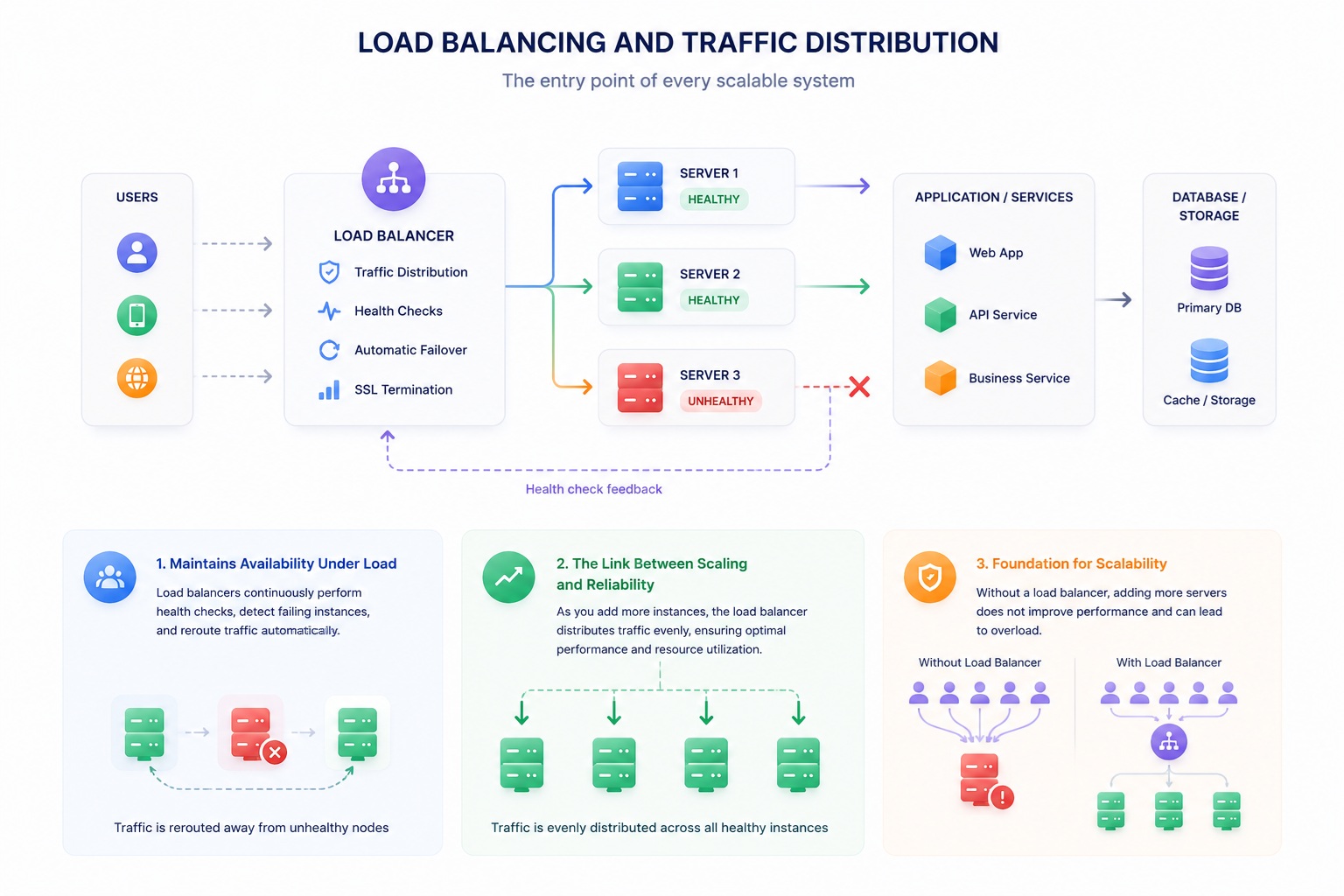
Load balancers are responsible for distributing incoming traffic across multiple backend instances. Without them, even well-designed systems cannot scale effectively.
They ensure that no single server becomes overloaded and that traffic is evenly distributed across available resources.
Maintaining Availability Under Load
Modern load balancers do more than just distribute requests. They perform health checks, detect failing nodes, and reroute traffic automatically. This allows systems to remain operational even when individual components fail.
This is a key requirement for high availability systems that must remain online regardless of partial failures.
The Link Between Scaling and Reliability
Load balancing is tightly connected with horizontal scaling. As more instances are added, the load balancer ensures that traffic is routed efficiently. Without this layer, adding servers does not actually improve performance.
When High Load Becomes a Real Business Problem
At some point, scaling stops being a technical discussion and becomes a business risk. Systems start affecting revenue, user retention, and operational costs directly.
This is where architecture decisions require experience, not experimentation.
Teams often underestimate how quickly complexity grows when moving from simple scaling to distributed systems. Load balancing, asynchronous processing, and message queues are not isolated solutions - they must work together as a coherent system.
If your product is already facing performance bottlenecks or preparing for rapid growth, building the right backend architecture early can prevent costly rework later.
We design and build high-load backend systems that handle real production traffic, not theoretical benchmarks.
From API design and rate limiting to distributed processing and infrastructure scaling, our team focuses on predictable performance, system stability, and long-term scalability.
How It All Comes Together
A high load backend is not built from isolated techniques. It is a coordinated system where each layer supports the others.
API design defines how requests are structured and processed. Rate limiting controls how many requests enter the system. Asynchronous processing ensures that heavy workloads do not block user interactions. Queues distribute work across services, and load balancers distribute traffic across infrastructure.
When these components are combined correctly, the system becomes predictable under growth. This predictability is what separates scalable systems from unstable ones.
Conclusion
Building a high load backend is not about complexity for its own sake. It is about introducing the right architectural decisions at the right time.
Efficient API design, controlled request flow, asynchronous processing, queue-based communication, and load balancing are not optional optimizations. They are the core mechanisms that allow systems to handle growth without breaking.
The systems that succeed at scale are not the ones that react to load. They are the ones designed for it from the beginning.