Top Generative AI Development and Consulting Companies in 2026
Generative AI has moved well beyond experimental chatbots. Companies are now integrating large language models into customer-facing products, internal knowledge systems, document workflows, search, analytics, support operations, and software platforms. The difficult part is increasingly the engineering around the model: data access, retrieval, evaluation, security, integrations, observability, and production reliability.
This comparison covers 12 generative AI development companies that work on those problems. Binerals is on this list. Here is how we picked the others.
Top Generative AI Development Companies at a Glance
Company | Best for | Generative AI focus | Hourly rate | Clutch rating |
|---|---|---|---|---|
Master of Code Global | Conversational AI | AI assistants, voice AI, NLP, customer-facing GenAI | $50-$99 | 4.7 (37 reviews) |
Azumo | Nearshore GenAI engineering | LLM apps, AI agents, RAG, integrations | $25-$49 | 4.9 (27 reviews) |
DataRoot Labs | Data-intensive GenAI | RAG, LLM applications, ML, AI product development | $50-$99 | 4.9 (23 reviews) |
Neoteric | GenAI product development | Text generation, image generation, AI strategy | $50-$99 | 4.9 (70 reviews) |
LeewayHertz | Enterprise GenAI programs | LLMs, RAG, multi-agent systems, AI applications | $50-$99 | 4.7 (9 reviews) |
HatchWorks AI | AI-native product engineering | GenAI, data engineering, enterprise AI transformation | $50-$99 | 4.9 (29 reviews) |
InData Labs | Data science and NLP | NLP, LLM solutions, ML, data-intensive AI | $50-$99 | 4.9 (20 reviews) |
10Clouds | Product-focused GenAI | Generative AI, AI consulting, custom software | $50-$99 | 4.9 (95 reviews) |
EffectiveSoft | Enterprise software + AI | NLP, AI integration, custom software | $50-$99 | 4.9 (19 reviews) |
Kanerika | Enterprise data + GenAI | GenAI, analytics, automation, AI agents | $100-$149 | 5.0 (19 reviews) |
Binerals | AI integration into existing products | RAG, LLM integration, copilots, AI agents | $25-$49 | 4.9 (14 reviews) |
Scopic | AI-enabled digital products | Generative AI, custom software, web and mobile | $50-$99 | 4.9 (70 reviews)* |
*Public marketplace data can change as companies receive new reviews or update their profiles. Rates are published vendor ranges rather than project quotations.
The table illustrates one important point: there is no universal best generative AI development company. A business building a conversational interface has different engineering requirements from an enterprise connecting an LLM to thousands of internal documents, and both differ from a SaaS company embedding AI into an established application.
How We Picked These Companies
We focused on development partners rather than foundation-model providers or standalone AI platforms. OpenAI, Anthropic, Google, and similar companies provide models and infrastructure that development teams can build on, but hiring them is fundamentally different from engaging an engineering company to design and implement a custom product.
The first criterion was practical generative AI capability. We looked for evidence of work involving LLM integration, retrieval-augmented generation, conversational AI, AI assistants, generative applications, or related production systems. A company did not qualify simply because its website had recently added "AI" to a broad software-development service list.
Production engineering was equally important. Generative AI applications depend on much more than model access. A credible implementation partner should be able to work with application architecture, APIs, databases, cloud infrastructure, authentication, permissions, data pipelines, monitoring, and the existing software around the model.
We also considered verified customer feedback, published hourly rates, team structure, and the ability to support a product after initial deployment. Clutch was used as a consistent third-party reference for pricing and review data where available, while company websites were used to evaluate stated AI capabilities and service focus.
Finally, the list deliberately includes different types of providers. Some specialize heavily in conversational AI or data science. Others combine generative AI with broader product engineering. That distinction matters because the right partner depends on how much of the surrounding software system also needs to be designed, built, or modernized.
1. Master of Code Global
Master of Code Global has one of the clearest specializations in conversational AI among the companies in this comparison. Its current Clutch profile assigns 25% of its services to AI development, 20% to AI agents, 20% to AI consulting, and 20% to generative AI. Within AI expertise, chatbots and conversational AI represent its largest stated focus.
That makes the company particularly relevant for customer-facing assistants, voice interfaces, commerce experiences, and other applications where conversation itself forms a substantial part of the product.
The company works across enterprise and mid-market clients and combines AI development with the software engineering required to connect assistants to business applications and data. Clutch currently lists a minimum project size of $25,000, an hourly rate of $50-$99, 50-249 employees, and a 4.7 rating from 37 reviews.
Best for: Companies building sophisticated customer-facing conversational AI, voice experiences, and AI assistants.2. Azumo
Azumo combines generative AI expertise with nearshore software engineering for North American companies. This is useful when an AI feature is part of a broader product rather than an isolated machine-learning project.
Its service mix includes AI development, AI agents, AI consulting, and generative AI alongside custom software development. That gives the company flexibility to work on the model layer and the surrounding backend, application, infrastructure, and integrations.
Azumo's current Clutch profile shows a $10,000 minimum engagement, an hourly rate of $25-$49, and a 4.9 rating. The generative AI-specific profile currently shows 27 reviews.
The combination of US presence and nearshore delivery can also be attractive to teams that want substantial working-hour overlap without paying typical onshore engineering rates.
Best for: US companies looking for nearshore teams to build LLM applications, AI agents, RAG systems, or AI features within existing software.3. DataRoot Labs
DataRoot Labs is a stronger fit when the generative AI problem is closely connected to data science and machine learning. Its work spans AI product development, LLM applications, RAG, machine learning, and broader data-driven engineering.
This distinction becomes important for products where generative AI is only one component of the system. An application may combine semantic retrieval with predictive models, structured data processing, recommendation logic, or other ML pipelines. Teams with a broader data science foundation can address these dependencies without treating the LLM as an isolated layer.
Clutch currently lists DataRoot Labs at $50-$99 per hour with a $10,000 minimum project size. The company has a 4.9 rating from 23 reviews, with reviewers frequently mentioning technical expertise, communication, and knowledge.
Best for: RAG systems and generative AI products with substantial data engineering or machine-learning requirements.4. Neoteric
Neoteric combines product development with AI consulting and implementation. Its current Clutch profile identifies generative AI work across text and image generation, while its AI consulting capabilities cover deployment, strategy, and maturation.
That product orientation can be useful for companies that have identified a promising AI opportunity but still need to translate it into a usable commercial application. Model selection is only one decision in that process. UX, application architecture, data flows, validation, deployment, and iteration can determine whether users actually adopt the resulting feature.
Clutch lists a $10,000 minimum project size, an hourly rate of $50-$99, and a 4.9 rating from 70 reviews.
Best for: Startups and established businesses turning generative AI concepts into customer-facing products.5. LeewayHertz
LeewayHertz is positioned toward broader enterprise AI initiatives. The company works across AI consulting, application development, intelligent agents, multi-agent systems, generative AI, and custom software.
Its approach is particularly relevant when a company needs to evaluate multiple models or build an architecture that extends beyond a single prompt-to-response workflow. LeewayHertz also develops ZBrain, its enterprise AI platform for building applications and agentic workflows.
Current Clutch data lists 50-249 employees, a $10,000 minimum engagement, an hourly rate of $50-$99, and a 4.7 rating from nine reviews. Generative AI represents 10% of its listed service mix, while AI agents and AI development each account for 25%.
Best for: Enterprises evaluating broader LLM architectures, RAG, custom AI applications, and multi-agent systems.6. HatchWorks AI
HatchWorks AI combines AI engineering with data and digital product development. Its positioning is built around AI-native solutions and helping companies develop the data foundation required to support them.
This is an important capability for enterprise generative AI because weak data architecture often becomes a larger limitation than the LLM itself. Internal assistants and RAG systems need reliable ingestion, access controls, metadata, retrieval logic, and mechanisms for keeping the underlying knowledge current.
HatchWorks has 250-999 employees according to Clutch and operates from Atlanta with additional locations. Its profile currently lists a $25,000 minimum project size, $50-$99 hourly rates, and a 4.9 rating from 29 reviews.
Best for: Mid-market and enterprise organizations that need generative AI engineering combined with data modernization.7. InData Labs
InData Labs brings a data science background to AI implementation. The company works across NLP, machine learning, predictive systems, and custom AI, making it suitable for generative AI projects that depend on substantial data preparation or domain-specific processing.
For example, enterprise LLM applications frequently need classification, extraction, semantic search, preprocessing, and retrieval before generation even begins. A team accustomed to traditional NLP and machine-learning pipelines can be useful when the architecture requires more than an API connection to a foundation model.
Clutch currently lists a $10,000 minimum project size, $50-$99 hourly rates, and a 4.9 rating from 20 verified reviews.
Best for: Data-heavy generative AI applications requiring NLP, machine learning, analytics, or custom data pipelines.8. 10Clouds
10Clouds combines generative AI with a long-established digital product engineering practice. Its Clutch profile includes generative AI, AI development, AI consulting, custom software, design, and data-related services.
This mix is particularly useful when generative AI needs to become part of a polished user-facing application. An AI assistant may require model orchestration behind the scenes, but its adoption still depends on conventional product concerns such as interface design, application performance, authentication, onboarding, and integration with existing workflows.
Clutch currently reports a $25,000 minimum project size, $50-$99 hourly rates, and a 4.9 rating from 95 reviews.
Best for: Businesses that need generative AI combined with mature product design and software engineering.9. EffectiveSoft
EffectiveSoft is a broader software engineering company with AI, NLP, data, and enterprise application capabilities. Its profile makes it more suitable for organizations where generative AI must be incorporated into a larger software environment rather than developed as a standalone application.
This can include adding conversational interfaces to existing platforms, introducing intelligent document workflows, connecting AI services to business applications, or modernizing software so that new AI capabilities can be deployed safely.
Current Clutch data shows a $25,000 minimum engagement and $50-$99 hourly rates. EffectiveSoft holds a 4.9 rating from 19 reviews, with clients frequently highlighting timely delivery, communication, quality, and flexibility.
Best for: Enterprise software projects where generative AI must integrate with existing applications and infrastructure.10. Kanerika
Kanerika combines generative AI with analytics, data modernization, and intelligent automation. This gives it a distinct position for organizations that want AI to operate on top of structured enterprise data and established business processes.
Clutch currently categorizes 15% of Kanerika's services as generative AI, 15% as AI development, 10% as AI agents, and 10% as AI consulting. Its broader portfolio includes data, automation, and digital engineering. The company also works with Microsoft, Databricks, and UiPath and lists offices across the United States, India, Argentina, and Singapore.
Its current Clutch profile shows 250-999 employees, a $10,000 minimum project size, an hourly rate of $100-$149, and a 5.0 rating from 19 reviews.
Best for: Enterprise generative AI connected to analytics, automation, governed data environments, and operational workflows.11. Binerals
Binerals approaches generative AI as part of broader product and software engineering rather than as a standalone model experiment. Its AI and ML practice covers generative AI and LLM integration, RAG architectures, fine-tuned language models, AI agents, copilots, NLP, data pipelines, and production monitoring.
This makes Binerals relevant when an existing SaaS platform or digital product needs an AI capability integrated into its current architecture. The team can work across model integration, APIs, backend systems, data pipelines, cloud infrastructure, and the application layer surrounding the AI functionality.
The company's current Clutch profile assigns 10% of its services to generative AI and lists conversational AI as its AI expertise. Clutch reports 50-249 employees, a $10,000 minimum project size, $25-$49 hourly rates, and a 4.9 rating from 14 reviews.
Best for: Companies adding RAG, LLM features, copilots, conversational AI, or AI agents to existing software products.12. Scopic
Scopic is a broader custom software development company that has expanded its AI capabilities while retaining web, mobile, desktop, and product engineering expertise.
That makes the company relevant for projects where generative AI is one feature within a more conventional digital product. Instead of separating AI implementation from application development, a full-cycle team can handle the user interface, backend, integrations, cloud infrastructure, and AI layer as a single delivery scope.
Scopic is therefore more comparable to a full-cycle software engineering partner than to a specialist LLM consultancy.
Best for: Companies building complete web, mobile, or SaaS products with embedded generative AI functionality.
Need a Generative AI Team for Your Product?
Discuss Your AI ProjectGenerative AI Development Companies by Use Case
The technical requirements behind "generative AI development" vary significantly. Selecting a vendor becomes easier when the comparison starts with the application rather than with the model.
RAG and Enterprise Knowledge Systems
DataRoot Labs, InData Labs, HatchWorks AI, LeewayHertz, and Binerals are relevant candidates when an application must generate answers from proprietary company information.
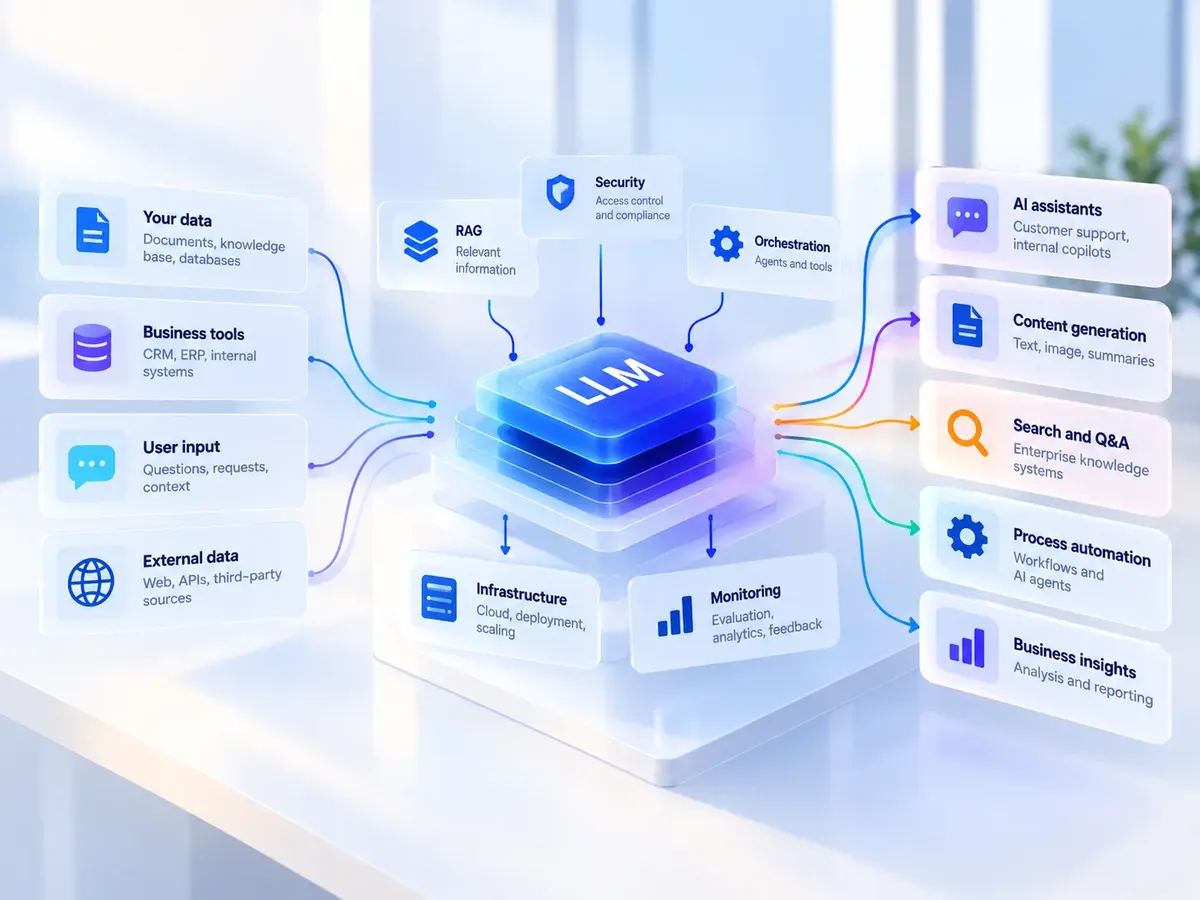
A production RAG system typically requires document ingestion, chunking, embeddings, retrieval, permissions, citations, evaluation, and mechanisms for updating the knowledge base. The quality of the final response depends on this entire retrieval pipeline rather than solely on the underlying LLM.
For organizations evaluating whether to build these capabilities internally or integrate existing AI technology, our AI integration guide examines the architectural and commercial trade-offs in more detail.
Conversational AI and Virtual Assistants
Master of Code Global has the strongest conversational specialization in this comparison, while Azumo and Binerals are relevant when conversational functionality must be integrated into a broader application or operational workflow.
Modern assistants may need to retrieve account information, call APIs, search internal knowledge, update CRM records, create tickets, or escalate conversations to people. That architecture is substantially different from a basic FAQ chatbot.
Businesses planning this type of product can also review our guide on how to build an AI chatbot, including the product and engineering decisions involved.
Generative AI for SaaS Products
Neoteric, 10Clouds, Azumo, Scopic, and Binerals are particularly relevant when generative AI is being embedded into an existing SaaS product or used as the foundation of a new one.
These projects require conventional product engineering alongside AI expertise. User management, billing, data storage, permissions, application performance, observability, UX, and integrations remain essential even when the product's central differentiator is an LLM.
Enterprise Generative AI
LeewayHertz, HatchWorks AI, EffectiveSoft, Kanerika, and InData Labs are stronger candidates for organizations with complex enterprise environments, substantial data dependencies, or integration requirements across multiple systems.
Enterprise buyers should pay particular attention to access control, auditability, data residency, model governance, evaluation, security, and human oversight. These requirements often determine architecture before a specific LLM is selected.
Need a Generative AI Team for Your Product?
A generative AI project becomes substantially more complex once it has to work with real company data, real users, and existing software.
Binerals helps companies integrate LLMs, RAG, AI assistants, copilots, and agentic functionality into production software while handling the surrounding backend, data, cloud, and application architecture.
Looking for a team for your AI project?
Discuss Your Project NowGenerative AI Consulting Companies vs. Development Partners
Generative AI consulting and generative AI development overlap, but buyers should understand the difference before choosing a vendor.
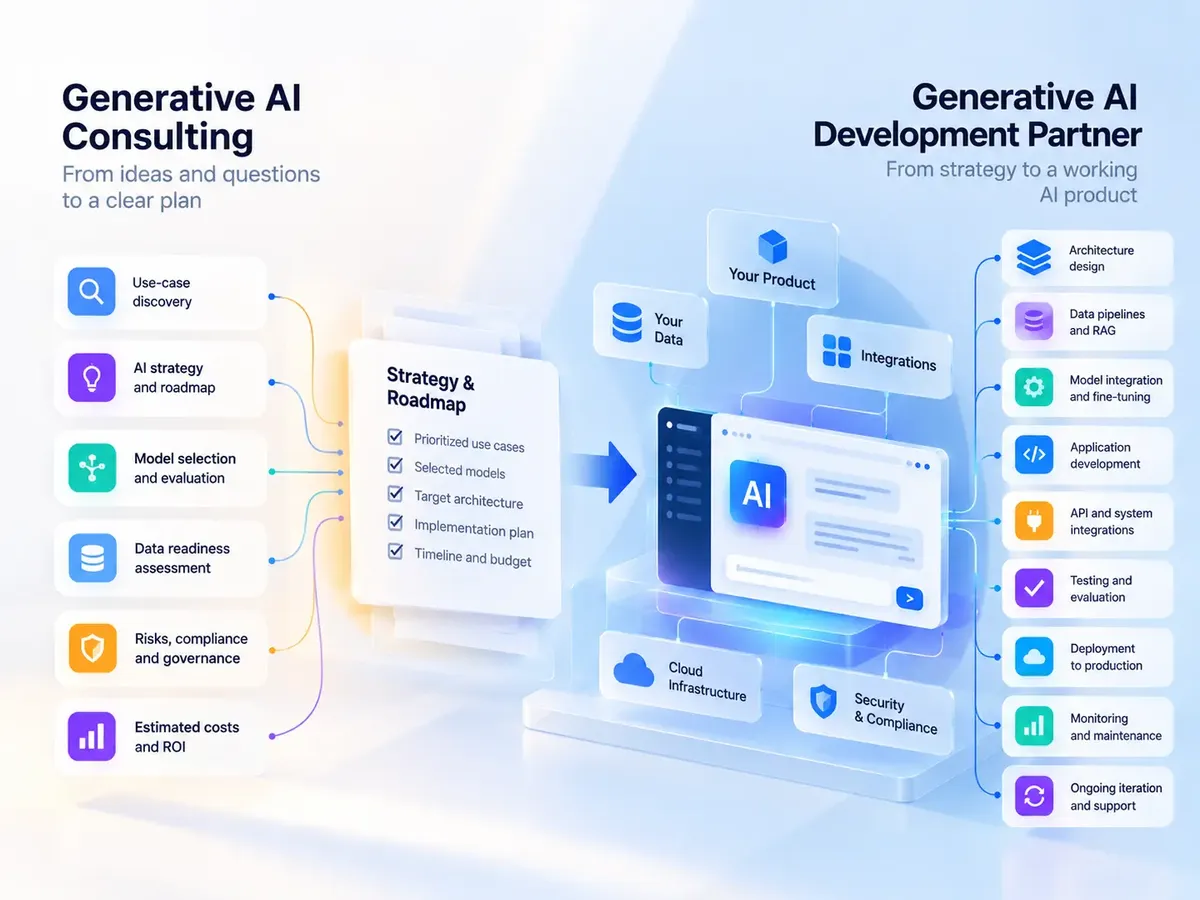
A consulting engagement is primarily useful when the organization has not yet defined what to build. Consultants can evaluate potential use cases, assess data readiness, compare foundation models, identify technical and regulatory risks, estimate expected costs, and develop an implementation roadmap.
A development partner becomes more important once the organization needs working software. That responsibility includes application architecture, data pipelines, RAG implementation, model integration, backend engineering, user interfaces, APIs, deployment, testing, monitoring, and ongoing optimization.
Some companies in this comparison cover both areas. The distinction should therefore be evaluated at the engagement level rather than simply by reading the vendor's service labels.
Requirement | GenAI consulting | GenAI development partner |
|---|---|---|
Use-case discovery | Strong | Usually included |
AI strategy | Strong | Moderate to strong |
Model selection | Strong | Strong |
RAG architecture | Design | Design + implementation |
Software engineering | Limited | Core capability |
API and system integration | Advisory | Core capability |
Production deployment | Sometimes | Core capability |
Monitoring and maintenance | Limited | Usually available |
Long-term product iteration | Limited | Strong |
Companies with strong internal engineering departments may only need consulting to define architecture and governance. Companies without dedicated AI engineers generally benefit more from a partner capable of taking responsibility from discovery through production.
How to Choose a Generative AI Development Company
Start by asking the vendor to explain a production system it has already delivered. The answer should go beyond the name of a model. A credible team should be able to discuss how data entered the system, how retrieval worked, how the model interacted with external tools, how outputs were evaluated, and how the application was monitored after deployment.
Ask how the team chooses between commercial and open-source models. GPT, Claude, Gemini, Llama, Mistral, and other models have different performance, cost, hosting, context, and privacy characteristics. A vendor should be able to justify model selection against your actual requirements rather than defaulting to a familiar provider.
For RAG applications, ask how retrieval quality will be measured. Poor retrieval can produce confident but incorrect answers even when the underlying model performs well. Evaluation should therefore cover retrieval relevance, answer quality, citation accuracy, latency, and failure scenarios.
Security deserves the same attention as model performance. Establish where prompts, documents, embeddings, and generated responses are stored, which providers can access them, how permissions are inherited from existing systems, and whether sensitive data can leave your infrastructure.
Finally, clarify ownership. Your contract should define ownership of application code, prompts, orchestration logic, fine-tuning assets, evaluation datasets, vector databases, infrastructure configuration, and any other project-specific intellectual property.
What Does Generative AI Development Cost in 2026?
Published Clutch rates among the companies in this comparison range from approximately $25 to $149 per hour. That range is useful for comparing vendors, but hourly rates alone say relatively little about the total project cost.
A focused proof of concept may require only one workflow and a limited dataset. A production RAG application can require ingestion pipelines, access controls, evaluation, user interfaces, monitoring, and integration with several existing systems. Enterprise implementations may also introduce compliance, private networking, audit logging, custom deployment environments, and human-review workflows.
Model usage creates an additional operating cost after development. Token consumption, embeddings, vector search, reranking, speech services, GPU infrastructure, and observability platforms can all contribute to recurring expenditure. The cheapest development quote can therefore become expensive if the resulting architecture uses models inefficiently or cannot control context size and request volume.
Buyers should ask vendors to estimate both implementation cost and expected operating cost at realistic usage levels.
Frequently Asked Questions
Build Generative AI Into Your Product With Binerals
Discuss Your AI Project