"Vertical vs Horizontal Scaling What Actually Works in Real Projects")
Vertical vs Horizontal Scaling: What Actually Works in Real Projects
Scaling is one of the most misunderstood aspects of high load system development. Many teams approach it as a purely technical decision, choosing between bigger servers or more servers without fully understanding the business impact behind that choice.
For businesses, scaling is not about infrastructure. It is about ensuring that growth does not break the product. When traffic increases, when concurrent users grow, and when system load becomes unpredictable, the way you scale determines whether your system remains stable or turns into a bottleneck.
The challenge is that there is no universally correct approach. Vertical scaling can be faster and cheaper at early stages, while horizontal scaling enables long-term growth but introduces significant architectural complexity. Choosing the wrong strategy at the wrong time leads either to wasted budget or to systems that cannot handle real demand.
In this article, we break down how vertical and horizontal scaling actually work in real projects, when each approach makes sense, and how to align scaling decisions with business goals rather than technical assumptions.
Scaling Is a Business Constraint, Not Just a Technical Choice
For businesses, high load means the moment when infrastructure decisions start directly affecting revenue, user experience, and operational stability. Scaling is the mechanism that determines how your system responds to that pressure.
At early stages, most products do not fail because they cannot scale. They fail because they scale incorrectly. Teams either overinvest in distributed architectures before they are needed or delay scaling decisions until performance degradation becomes visible to users.
A scalable web application is not defined by how many servers it runs on. It is defined by how predictably it handles growth. This predictability is what separates controlled scaling from reactive firefighting.
Vertical Scaling: When Simplicity Wins
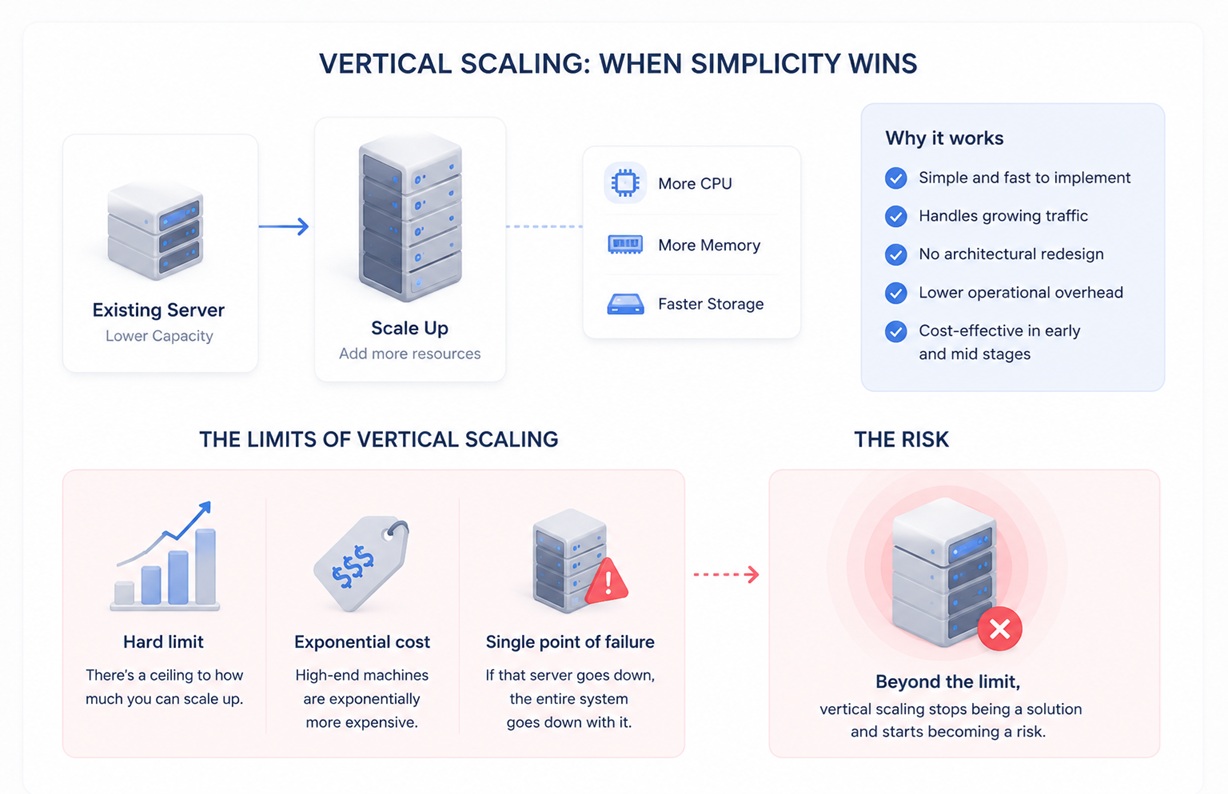
Vertical scaling, or scaling up, is the most straightforward way to handle increasing load. You take an existing server and increase its capacity - more CPU, more memory, faster storage.
In real-world projects, this approach is often underestimated. For a large percentage of products, especially in early and mid stages, vertical scaling is not only sufficient but optimal. It allows teams to handle increasing traffic without introducing distributed system complexity, without redesigning architecture, and without increasing operational overhead.
For businesses, high load means making decisions that balance speed and cost. Vertical scaling aligns well with this principle because it enables rapid response to growth without significant engineering investment. If your bottleneck is purely resource-based, upgrading infrastructure is often the fastest way to stabilize the system.
However, vertical scaling has a hard limit. At some point, adding more resources becomes either technically impossible or economically inefficient. High-end machines are exponentially more expensive, and they still represent a single point of failure. If that server goes down, the entire system goes down with it.
This is where vertical scaling stops being a solution and starts becoming a risk.
Horizontal Scaling: When Growth Becomes Architecture
Horizontal scaling, or scaling out, changes the problem entirely. Instead of making one machine stronger, you distribute load across multiple machines.
This is the foundation of any high-load system development approach that aims to handle large volumes of traffic and concurrent users. It allows systems to grow almost indefinitely by adding more nodes instead of upgrading a single one.
But horizontal scaling is not just an infrastructure decision. It is an architectural commitment.
To make it work, your system must support distributed execution. This requires stateless services, load balancing, data partitioning, and often event-driven communication. Without these, adding more servers does not actually solve the problem - it just replicates the bottleneck.
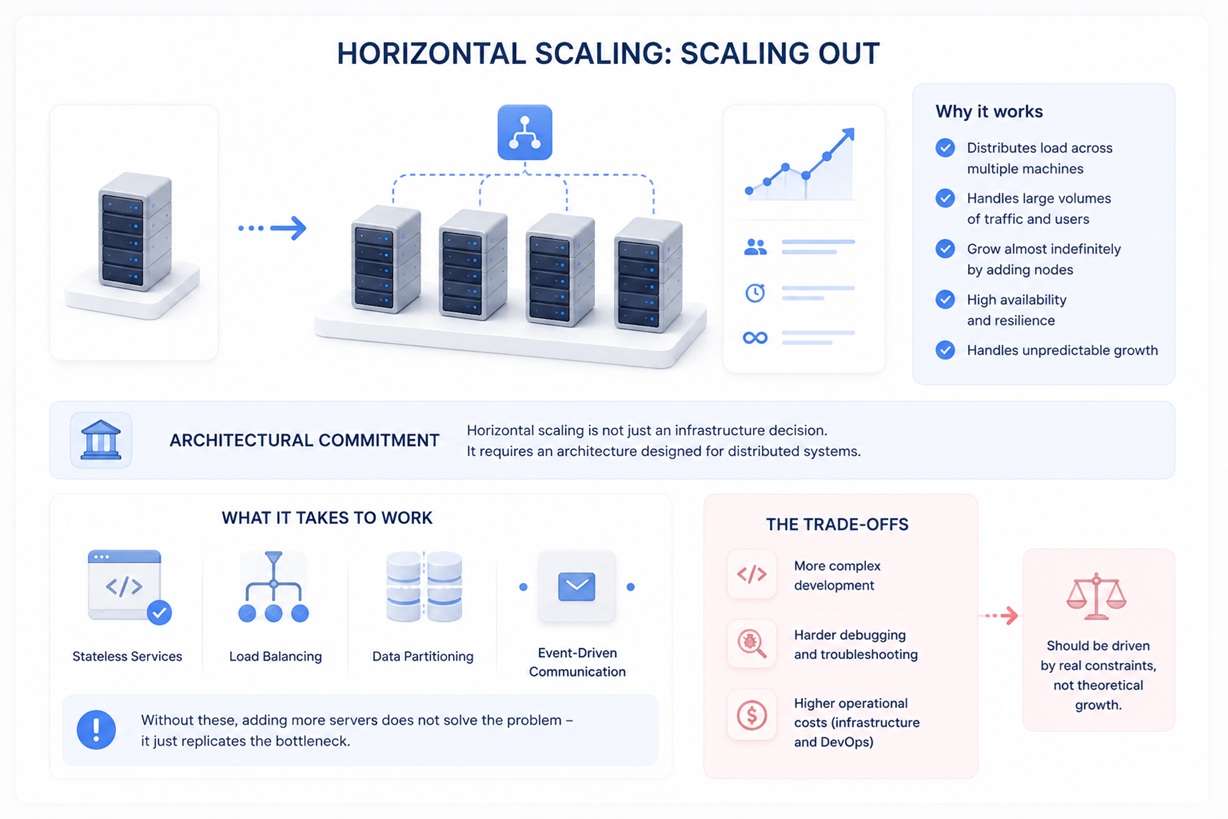
For businesses, high load means the ability to handle unpredictable growth. Horizontal scaling enables this, but it comes with trade-offs. Development becomes more complex, debugging becomes harder, and operational costs increase due to infrastructure and DevOps requirements.
This is why horizontal scaling should not be introduced prematurely. It should be driven by real constraints, not theoretical growth.
The Real Trade-Off: Cost vs Complexity vs Control
The decision between vertical and horizontal scaling is rarely binary. In practice, real systems combine both approaches.
Vertical scaling is often used as the first response to growth. It provides immediate relief and buys time. Horizontal scaling is introduced later, when system scalability becomes a structural requirement rather than a temporary fix.
For businesses, high load means navigating this transition correctly.
If you move to horizontal scaling too early, you increase costs and slow down development without immediate benefit. If you delay it too long, you risk hitting infrastructure limits and facing emergency redesign under pressure.
The key insight is that scaling is not about choosing a model. It is about evolving from one to another at the right time.
Planning to scale your product under real load?
Talk to engineers who have done it beforeHandling High Traffic and Concurrent Users in Practice
In real projects, scaling challenges rarely come from total traffic alone. They come from concurrency and usage patterns.
A system with moderate traffic but high concurrency can fail faster than one with higher total load but more predictable behavior. This is why scaling decisions must consider how users interact with the system, not just how many users there are.
Handling high traffic effectively requires a combination of strategies. Load balancing distributes requests across servers. Caching reduces repeated computation. Asynchronous processing removes heavy operations from critical user flows. Together, these techniques reduce pressure on the system and make scaling more efficient.
For businesses, high load means designing systems that remain stable under peak conditions, not just average ones.
When Vertical Scaling Is Enough - And When It Is Not
There is a clear threshold where vertical scaling stops being effective.
If your system can still handle growth by upgrading resources without significant cost increase, vertical scaling remains the best option. It keeps architecture simple and development fast.
However, once you start facing resource limits, performance bottlenecks that cannot be solved by hardware, or increasing risk of downtime, horizontal scaling becomes unavoidable.
At that point, scaling a web application is no longer about infrastructure upgrades. It becomes about redesigning how the system works.
Scaling too early costs money. Scaling too late costs your product.
Let’s find the right balance!Scaling Strategy Is Part of High Load System Development
Scaling decisions are not isolated. They are part of a broader high-load system development strategy that includes architecture, data management, and operational practices.
For businesses, high load means understanding that infrastructure is not static. It evolves together with the product. The goal is not to build the most scalable system from the start, but to build a system that can become scalable without disruption.
This requires planning, but not overengineering. It requires flexibility, but not chaos.
Conclusion
Vertical and horizontal scaling are not competing approaches. They are stages of system evolution.
Vertical scaling provides speed and simplicity. Horizontal scaling provides resilience and long-term growth. The challenge is not choosing one over the other, but knowing when to transition.
For businesses, high load means reaching a point where scaling decisions directly affect revenue, reliability, and user experience. At that point, scaling is no longer a technical optimization. It becomes a strategic decision.
The most successful systems are not the ones that scale the most. They are the ones that scale at the right time, in the right way, with the right level of complexity.