"Building Fault-Tolerant Systems: How to Avoid Downtime Under High Load")
Building Fault-Tolerant Systems: How to Avoid Downtime Under High Load
A system that performs well under heavy traffic is not necessarily a system that can survive failure. Load testing may demonstrate that an application can process thousands of requests per second, horizontal scaling may provide additional capacity during traffic spikes, and database optimization may keep queries responsive as data volume grows. None of these guarantees that the application will remain available when an infrastructure component disappears unexpectedly or one of its dependencies begins responding slowly.
This distinction becomes increasingly important as systems grow. A modern application may depend on several application instances, databases and replicas, caches, queues, payment providers, authentication services, storage systems, third-party APIs, and cloud infrastructure distributed across multiple availability zones. Every additional dependency introduces another place where something can fail, and under high load the consequences can propagate much faster because thousands of requests may be competing for the same resources at the moment the problem begins.
Fault-tolerant architecture starts from a different assumption than conventional defensive programming. Instead of asking how to prevent every component from failing, it assumes that individual components will eventually fail and asks what the rest of the system should do when that happens. This approach is consistent with modern cloud architecture guidance, which treats redundancy, failure isolation, health monitoring, circuit breakers, and controlled recovery as fundamental reliability mechanisms.
In this guide, we will examine how redundancy removes single points of failure, how automated failover keeps traffic moving when infrastructure becomes unavailable, how circuit breakers contain failures before they cascade, and why graceful degradation can be more valuable than attempting to keep every feature fully operational during an incident.
Fault Tolerance Is Different From Scaling
Scalability and fault tolerance are closely related, but they solve different problems. Scalability asks whether the system can continue operating when demand increases, while fault tolerance asks whether it can continue operating when part of the system becomes unavailable.
A horizontally scaled application may run across ten servers and comfortably handle a major traffic spike, but if every server depends on a single database instance, that database remains a single point of failure. Similarly, a replicated database does little to protect availability if the application cannot detect that the primary is unavailable and redirect operations to a healthy replica.
This is why our earlier discussion of high-load architecture emphasized avoiding single points of failure as one of the core principles of scalable system design. Redundancy, load balancing, failover mechanisms, and distributed components are not simply techniques for increasing capacity. They determine whether one failure can take down the entire application.
At high traffic volumes, the distinction becomes even more important because load can amplify failure. When one instance disappears, its traffic moves somewhere else. When a cache becomes unavailable, requests return to the database. When a downstream API slows down, application threads and connections remain occupied for longer. A component failure therefore does not merely remove capacity. It can increase pressure on everything that remains healthy.
A fault-tolerant architecture has to account for this redistribution of pressure rather than assuming that redundancy alone solves the problem.
Redundancy: Remove the Single Point of Failure
The simplest principle behind fault tolerance is that a critical function should not depend on one irreplaceable component.
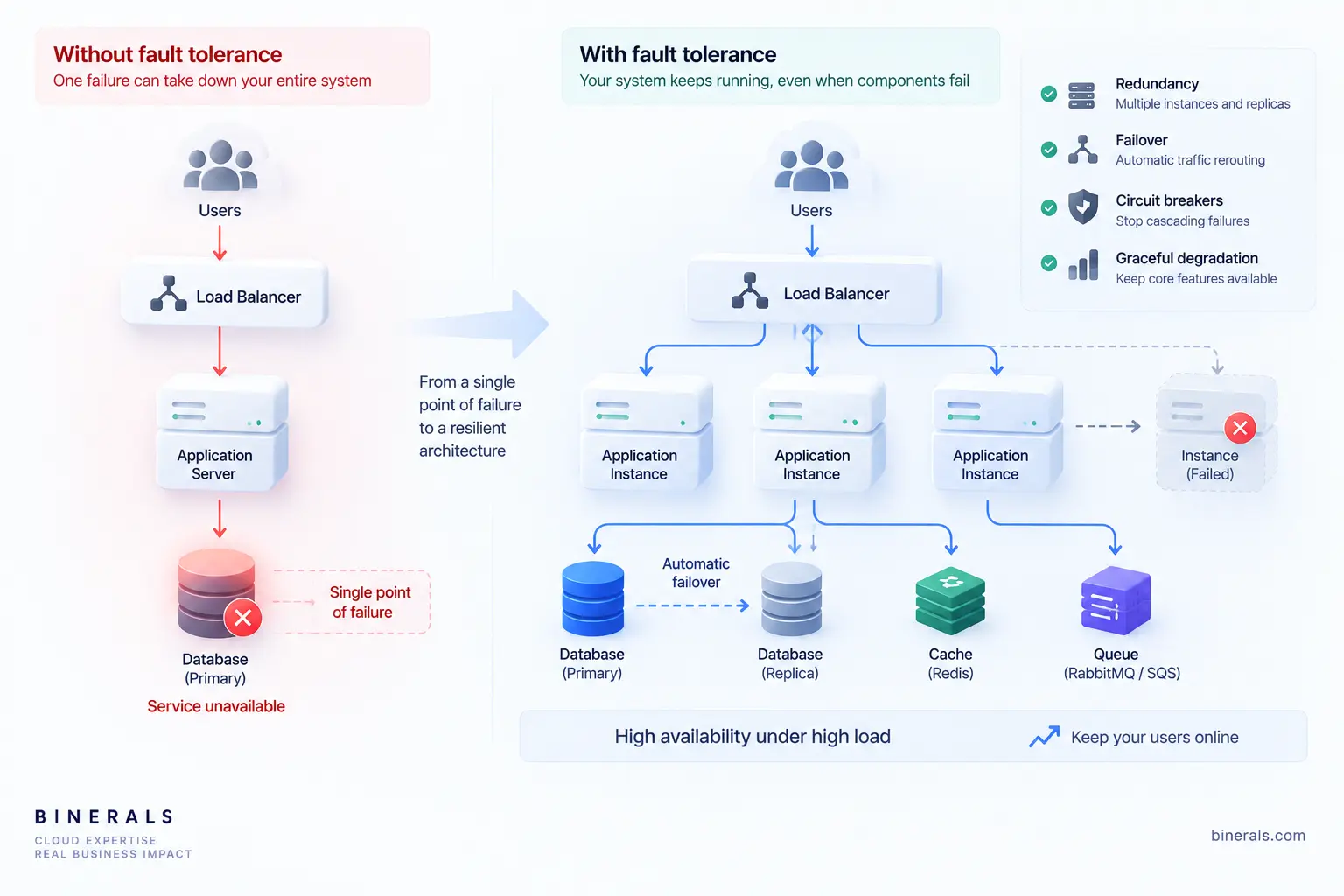
If an application runs on a single server, that server is a single point of failure. If several application servers depend on one database, the database becomes the single point of failure. If all infrastructure runs in one availability zone, the zone itself can become the failure boundary.
Redundancy introduces additional instances, replicas, zones, or regions so that the failure of one component does not eliminate the capability it provides. Azure's current architecture guidance explicitly recommends redundancy through mechanisms such as multiple application instances, database replicas, load balancers, and multi-zone or multi-region deployments, with the required level determined by business requirements and risk tolerance.
Application-level redundancy
Stateless application services are relatively straightforward to replicate because no individual instance needs to own the user's persistent state. Multiple instances can run behind a load balancer, which distributes incoming traffic among healthy nodes.
If one instance fails, the load balancer should stop sending traffic to it and continue routing requests to the remaining instances. New capacity can then be created automatically if the infrastructure supports autoscaling.
This is one reason stateless architecture is so important in high-load environments. The easier an application instance is to replace, the easier it becomes to treat individual machines or containers as disposable infrastructure rather than irreplaceable servers.
Database redundancy
Databases are more complicated because redundancy also requires data synchronization and a clear understanding of which node is allowed to accept writes.
Replication creates additional copies of data that can improve both read scalability and availability. As we discussed in our database scaling guide, replicas can distribute read traffic and provide additional resilience, although replication introduces consistency and synchronization trade-offs.
A replica becomes useful for fault tolerance only when there is a reliable process for promoting it or redirecting traffic after the primary fails. This is where redundancy and failover begin to overlap.
Redundancy across failure domains
Running three application instances on the same physical host or inside the same failure domain provides much less protection than distributing them.
For business-critical systems, redundancy should be considered at several levels: process, instance, host, availability zone, and, where justified by recovery requirements, region. The farther redundancy extends, the larger the class of failures the architecture can tolerate, but the higher its cost and operational complexity become.
This is why "make everything redundant" should not be interpreted as "duplicate everything everywhere." The architecture should reflect the cost of downtime, required recovery objectives, consistency requirements, and the realistic failures the business needs to survive.
If one failed component can still take down your entire platform, the architecture is not finished.
Learn moreFailover Turns Redundancy Into Availability
Redundancy gives the system somewhere else to run. Failover determines whether it can actually get there.
Consider a database with a healthy standby replica. If the primary fails at 14:02 but the engineering team needs 30 minutes to discover the problem, promote the replica, update configuration, and restart affected services, the architecture technically has redundancy but users still experience a 30-minute outage.
A fault-tolerant system aims to automate as much of that transition as the business requirements justify.
Health checks are the foundation of failover
Failover depends on knowing whether a component is healthy enough to receive traffic.
This is more complicated than checking whether a process is running. An application instance can respond to a basic health endpoint while being unable to reach its database. A database can accept connections while experiencing latency severe enough to make the application effectively unavailable.
Useful health checks therefore need to distinguish between different kinds of health. A liveness check answers whether the process itself is functioning, while readiness determines whether the instance is currently capable of serving real traffic.
Once an instance is considered unhealthy, load balancers, orchestrators, or service discovery systems can remove it from rotation while recovery takes place.
Automatic failover should have a defined target
Failover can occur at multiple layers. Traffic may move between application instances, a database replica may become primary, a Kubernetes workload may be rescheduled onto another node, or a global traffic manager may redirect users to another region.
The important question is not simply whether failover exists, but what failure it is designed to survive.
A multi-instance deployment protects against an individual instance failure. Multi-zone architecture extends protection to availability-zone problems. Multi-region architecture can survive a broader regional failure but introduces much greater complexity around replication, consistency, routing, deployment, and cost.
The correct design depends on how much downtime and data loss the business can tolerate.
Failover itself needs to be tested
An architecture diagram showing a primary and standby does not prove that failover works.
DNS behavior, stale service discovery information, database promotion, connection pools, cached configuration, replication lag, authentication, and dependent services can all behave differently during a real transition.
Failover procedures therefore need to be exercised under controlled conditions. If the first time a team tests database promotion is during a production outage, the system does not have a reliable failover strategy. It has an assumption.
This complements the load-testing approach used in high-load engineering, where systems are validated against realistic peak conditions rather than theoretical capacity. The same principle should be applied to failure.
Redundancy Does Not Prevent Cascading Failures
A system can contain redundant infrastructure and still experience a complete outage if failures are allowed to propagate between components.
Imagine that an application depends on a recommendation service. Under heavy traffic, that service begins responding slowly. Application requests wait for the recommendation response, which keeps threads and network connections occupied. More requests arrive while previous ones are still waiting, connection pools begin filling, memory consumption increases, and eventually the application itself becomes unable to serve requests that have nothing to do with recommendations.
The recommendation service was not essential to checkout, authentication, or account management, but its failure has now affected all of them.
This is a cascading failure.
High-load architecture therefore needs mechanisms that isolate faults and limit their blast radius. The Bulkhead pattern is one example. It separates resources or service instances into isolated pools so that a failure or overload in one pool does not consume the resources required by unrelated parts of the system. Microsoft describes this pattern specifically as a way to prevent resource exhaustion and cascading failures across services and consumers.
For example, calls to an external recommendation provider and a payment provider should not necessarily compete for the same connection pool. If the recommendation dependency stops responding, exhausting its isolated pool should not prevent checkout from accessing the payment service.
This kind of isolation introduces some resource overhead, but that inefficiency can be intentional. Fault tolerance is often about reserving enough separation that one problem cannot consume every available resource.
Circuit Breakers Stop Calling Services That Are Already Failing
One of the most important patterns for controlling cascading failures is the circuit breaker.
Distributed applications constantly communicate with resources that can become slow or unavailable. When a request fails, retrying may seem like the obvious response. For short transient failures, a limited retry can indeed be appropriate. The problem begins when hundreds or thousands of concurrent requests repeatedly retry a dependency that is already overloaded.
Instead of helping, the application creates additional load precisely when the dependency has the least capacity to handle it.
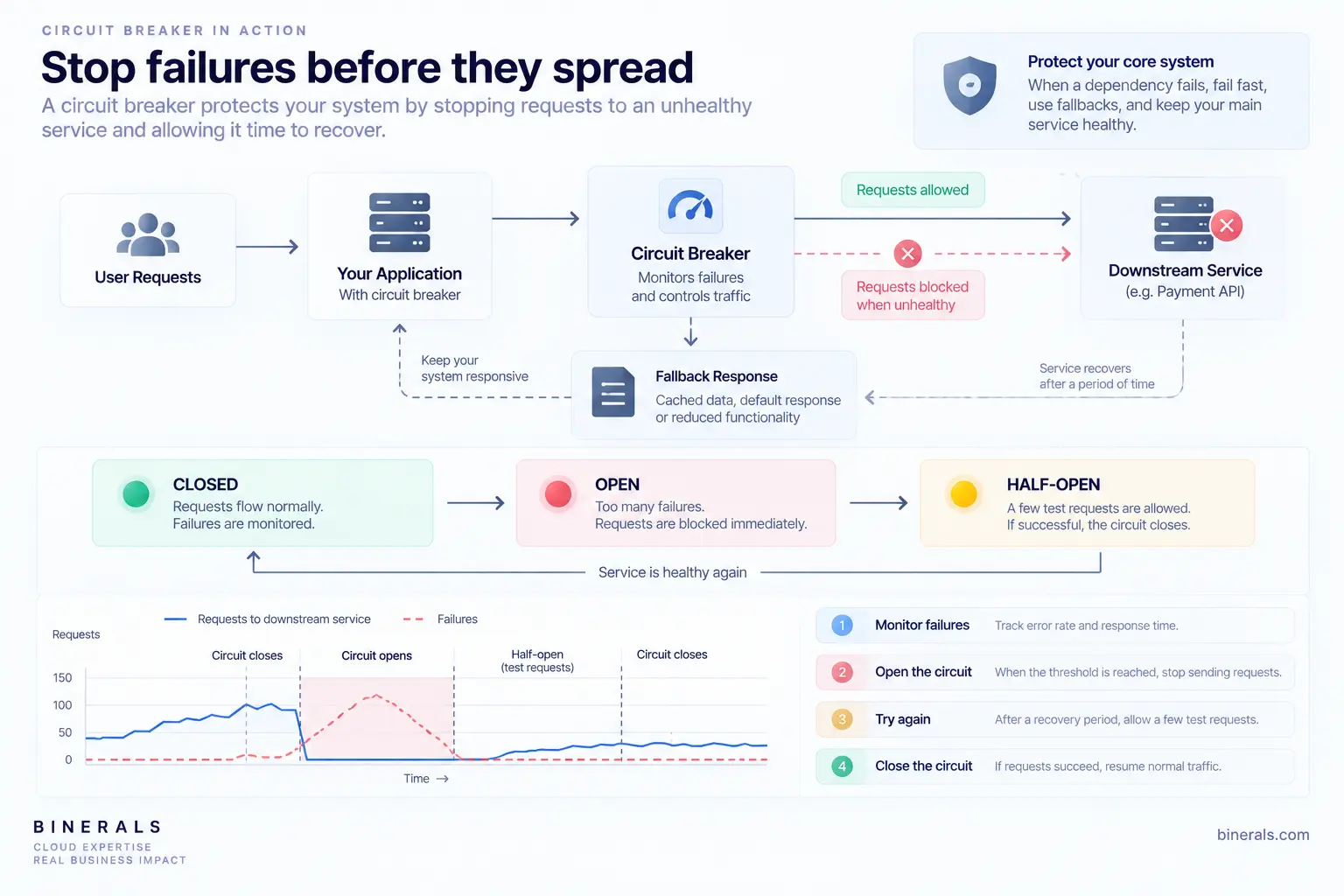
Microsoft's Circuit Breaker pattern addresses this by temporarily blocking calls to a dependency after failures reach a defined threshold. Requests can then fail quickly or use an alternative response instead of waiting for operations that are unlikely to succeed. This reduces wasted resources, protects the failing service while it recovers, and helps prevent the problem from spreading through the rest of the system.
Closed, open, and half-open states
A circuit breaker is typically modeled using three states.
In the closed state, requests flow normally and failures are monitored. Occasional errors do not necessarily indicate a serious problem, so the breaker remains closed until failures cross an appropriate threshold within a defined period.
When that threshold is exceeded, the circuit opens. New calls to the failing dependency are rejected immediately rather than being allowed to wait for another timeout.
After a recovery period, the breaker moves into a half-open state and permits a limited number of test requests. If those requests succeed, normal traffic can gradually resume and the circuit closes. If they fail, the breaker opens again and the dependency receives more time to recover.
This approach turns failure handling into a controlled state transition rather than an uncontrolled stream of retries.
Retry and circuit breaker solve different problems
Retries are useful when a failure is likely to be temporary. A brief network interruption or momentary throttling event may disappear before the next attempt.
Circuit breakers address a different situation: repeated requests are unlikely to succeed and continuing to send them may make the incident worse.
The distinction matters particularly under high load because retries multiply traffic. If 10,000 requests fail and each automatically performs three retries, the downstream dependency may receive tens of thousands of additional requests while already struggling.
Current Azure guidance recommends finite retry counts, exponential backoff, and retry budgets that limit aggregate retry traffic across a service rather than considering each request independently.
A resilient system therefore does not simply "retry on error." It determines which failures are transient, limits retry behavior, and stops attempting calls when continued retries become harmful.
Graceful Degradation: Keep the Important Parts Working
Fault tolerance does not always mean maintaining 100 percent of functionality.
Sometimes the safest response to an incident is deliberately providing less.
Graceful degradation allows a system to disable or simplify non-critical functionality while preserving the workflows that matter most. Microsoft includes this principle in its guidance for mission-critical workloads, recommending that degradation boundaries be designed explicitly so that dependent workflows can continue, queue work for later, or provide an alternative response when downstream services are unavailable.
Consider an ecommerce platform experiencing problems with its recommendation engine. The product page does not necessarily need to fail because "You may also like" cannot be calculated. The application can hide recommendations and continue serving product information, inventory, cart, and checkout.
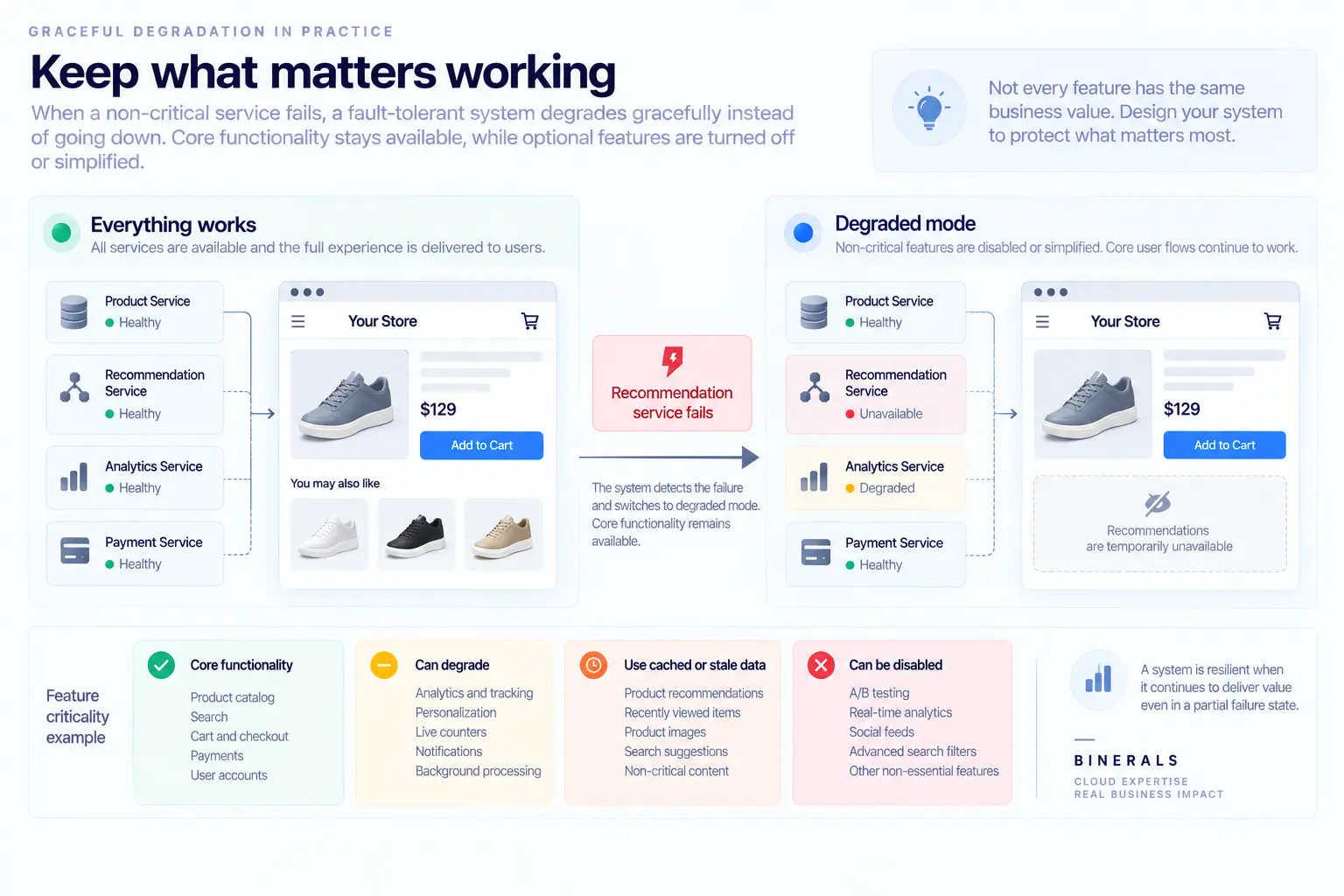
If a real-time analytics service becomes unavailable, events can potentially be buffered or queued rather than making the user wait. If personalized content cannot be generated, the application may serve cached or generic content. If a secondary search enhancement fails, basic search may remain available.
The key is deciding these fallbacks before the incident occurs.
Not every feature has equal business value
Graceful degradation works best when teams classify system capabilities by criticality.
Authentication, checkout, payment processing, account access, and core transactional workflows may need the strongest availability guarantees. Recommendations, analytics, live counters, personalization, previews, and other secondary functionality may be allowed to degrade temporarily.
The correct hierarchy depends entirely on the product.
A recommendation service might be optional for an online store but central to the value proposition of another platform. An analytics pipeline might be allowed to lag for several hours in one business but be mission-critical in a fraud detection system.
Fault tolerance therefore requires product decisions as much as infrastructure decisions.
Cached and stale data can be better than no data
Caching can also become a resilience mechanism.
A cache is normally introduced to reduce latency and backend load, but under some failure conditions a recently cached result may allow the application to continue serving useful information while the origin is unavailable. Azure's reliability patterns explicitly note that caching can preserve availability for frequently accessed data in some scenarios.
This does not mean stale data is always acceptable. The decision depends on the domain. Serving a product description that is several minutes old may be harmless, while serving stale financial balances or inventory during checkout may create serious problems.
The fallback policy should therefore define which data can safely become stale and for how long.
High availability is not about keeping every feature alive at any cost. It is about protecting the workflows the business cannot afford to lose.
Implement it with usAsynchronous Architecture Creates Another Layer of Resilience
Synchronous dependencies create direct failure paths. If Service A cannot complete its request until Service B responds, a failure or slowdown in Service B immediately affects Service A.
Asynchronous processing can break this dependency where immediate completion is unnecessary.
Instead of waiting for a downstream operation, the application can place work into a queue and continue processing the user request. Consumers then process that work independently according to available capacity.
This architecture does more than improve scalability. It can absorb temporary downstream failures because work accumulates in the queue rather than disappearing or forcing upstream requests to remain open indefinitely.
Binerals uses this principle in its high-load engineering approach, where operations that do not need to remain in the synchronous request lifecycle can be moved into reliable pipelines using technologies such as RabbitMQ, Kafka, or SQS.
However, queues do not eliminate failure. They move it into a form that can be managed differently. Queue depth, message age, consumer lag, retries, dead-letter queues, idempotency, and duplicate processing all need to be considered.
This is where fault tolerance connects directly with monitoring. A queue can successfully protect the user-facing application from a downstream outage while quietly accumulating millions of unprocessed messages. Without observability, the architecture has merely delayed the incident.
Fault Isolation Matters as Much as Redundancy
A reliable system should not only have spare capacity. It should be designed so that failures remain contained.
This concept is often described as limiting the blast radius.
Bulkheads provide one mechanism by isolating resources. Separate queues can prevent low-priority workloads from blocking critical ones. Dedicated connection pools can isolate problematic dependencies. Tenant partitioning can prevent one unusually active customer from exhausting resources used by everyone else. Deployment cells or stamps can divide a large platform into smaller independently operating units.
Microsoft's reliability guidance recommends both Bulkhead and Deployment Stamp patterns as mechanisms for containing failures so that an unavailable component or scale unit does not necessarily affect the entire workload.
This principle becomes especially important in multi-tenant and high-volume platforms because a failure affecting one customer, workload, or service should ideally remain confined to that boundary.
A system where every component shares every resource may be efficient during normal operation, but it can create an enormous blast radius during abnormal conditions.
Fault tolerance often requires accepting some duplication or underutilized capacity in exchange for isolation.
Failover Without Observability Is Dangerous
Automated recovery mechanisms need reliable signals.
A circuit breaker needs failure and latency thresholds. A load balancer needs health checks. Autoscaling requires utilization or application metrics. Database failover needs replication and health information. Operations teams need to know when the system has entered a degraded state even if users can still complete their primary workflows.
Monitoring therefore becomes part of the control system rather than merely a reporting layer.
(Internal link here: "How to Monitor High Load Systems: Metrics, Logs, and Real-Time Alerts")
Teams should monitor not only whether components are currently healthy, but also whether resilience mechanisms are being activated. Circuit breaker state changes, failover events, replica promotion, queue growth, retry rates, cache fallback usage, degraded-mode traffic, and unavailable dependencies all provide important operational information.
A system can appear available while silently operating without redundancy after one replica has failed. If another component fails before the first is restored, what appeared to be a healthy platform may suddenly experience a complete outage.
The monitoring strategy therefore needs to expose reduced redundancy as a risk even before users are affected.
Fault Tolerance Needs Capacity Headroom
Redundancy creates another problem that is easy to overlook: surviving a failure usually means the remaining infrastructure has to absorb additional load.
Suppose four application instances normally operate at 80 percent capacity. If one disappears, the remaining three may not have enough headroom to accept its traffic. The system technically has redundancy, but the failover itself pushes healthy instances beyond their limits.
This is particularly dangerous during peak traffic because the failure may occur precisely when infrastructure is already heavily utilized.
Fault-tolerant capacity planning should therefore consider the system after a component has failed, not only during normal operation. Depending on reliability requirements, infrastructure may be designed around N+1 capacity, zone failure scenarios, or other redundancy models that ensure sufficient resources remain available after losing part of the fleet.
Autoscaling can help, but it should not be treated as instantaneous recovery. New instances may require time to provision, initialize, warm caches, establish connections, and become ready for traffic.
Capacity planning and fault tolerance therefore have to be considered together.
How to Design a Fault-Tolerant High-Load System
There is no single architecture that guarantees fault tolerance. The appropriate design depends on traffic patterns, data consistency requirements, business criticality, recovery objectives, infrastructure budget, and the consequences of downtime.
A practical process begins by mapping dependencies and identifying single points of failure. Teams should understand what happens if each database, cache, queue, service, external API, zone, or infrastructure component becomes unavailable.
The next step is to classify those dependencies by criticality. Some components need redundancy and immediate failover, while others can degrade, return cached data, queue work, or become temporarily unavailable without threatening the core product.
Redundancy should then be introduced where losing a component would otherwise stop a critical workflow. Health checks and failover mechanisms need to be designed around real service readiness rather than process existence alone.
At the application level, timeouts, controlled retries, circuit breakers, bulkheads, and resource isolation prevent dependency failures from consuming the rest of the system. Asynchronous processing can decouple workflows that do not require immediate completion, while graceful degradation preserves critical functionality when optional capabilities are unavailable.
Finally, the architecture has to be tested under failure rather than merely reviewed on a diagram. Nodes should be terminated, dependencies made unavailable, database failover exercised, queues stressed, latency injected, and traffic increased while components are deliberately removed.
A system is not fault tolerant because its architecture contains redundant boxes.
It is fault tolerant when those boxes can actually fail and the product continues operating within its defined reliability objectives.
Designing for failure is much cheaper than discovering your failure boundaries during peak traffic.
Learn moreFault Tolerance Is a Business Decision
Every additional layer of resilience has a cost.
Running replicas consumes infrastructure. Multi-zone and multi-region deployments increase operational complexity. Reserved capacity may remain unused during normal operation. Stronger consistency can reduce availability. More isolation can reduce resource efficiency. Sophisticated failover mechanisms require testing and maintenance.
The objective is therefore not maximum theoretical availability at any price.
A marketing website, an internal reporting system, a payment platform, and a healthcare application do not require identical resilience architectures because the consequences of downtime differ dramatically.
Architecture should begin with business questions. How much does an hour of downtime cost? How much data can the business afford to lose? Which workflows must remain available? How quickly must service be restored? Which features can temporarily degrade without creating serious consequences?
The technical design should follow those answers.
This is also why Binerals' high-load engineering approach begins with architecture review and bottleneck analysis rather than automatically adding infrastructure. Reliability improvements need to target the failure modes that matter to the actual product.
Conclusion
Fault tolerance is not the ability to prevent failure. In sufficiently large systems, preventing every failure is impossible because hardware fails, networks become unreliable, dependencies slow down, software contains defects, infrastructure reaches capacity, and unexpected traffic eventually exposes assumptions that looked reasonable during development.
The more useful objective is to control what happens next.
Redundancy ensures that a critical capability does not depend on one component. Failover moves work toward healthy infrastructure when something becomes unavailable. Circuit breakers stop failing dependencies from consuming resources across the rest of the application. Bulkheads and isolation limit the blast radius of incidents, while asynchronous processing allows work to wait safely instead of forcing every dependency to remain available at the same moment. Graceful degradation protects essential workflows by deliberately sacrificing functionality that the business can temporarily operate without.
These mechanisms are most effective when they are designed together. Redundancy without failover may still produce downtime. Failover without capacity headroom can overload the surviving infrastructure. Retries without circuit breakers can amplify an outage. Graceful degradation without product-level prioritization can disable the wrong functionality. Automation without monitoring can leave the system operating in a fragile state without anyone realizing it.
A fault-tolerant high-load system therefore does not promise that nothing will break. It is designed so that when something does break, the failure remains contained, recovery begins automatically where possible, and the most important parts of the product continue working.