"High Load and Security: How to Protect Your System at Scale")
High Load and Security: How to Protect Your System at Scale
Security becomes a different engineering problem when a product starts operating at scale. In a smaller application, a sudden increase in requests may be inconvenient but manageable. In a high-load environment, the same pattern can consume network capacity, exhaust application workers, saturate database connections, overwhelm authentication services, or generate infrastructure costs long before engineers determine whether the traffic is legitimate.
The difficulty is that a high-load system is intentionally designed to accept large volumes of traffic. Autoscaling adds capacity when demand increases, load balancers distribute requests across additional instances, caches absorb repeated reads, and distributed infrastructure makes more resources available as the product grows. Those same characteristics can complicate security because malicious traffic may initially look like legitimate growth.
The problem is broader than DDoS attacks. A single client can generate excessive API traffic. Credential stuffing can create enormous authentication workloads. Expensive endpoints can be abused with relatively few requests. Bots can repeatedly bypass caches and force database operations. Compromised credentials can expose increasingly large datasets as the underlying platform scales.
Security controls therefore need to scale together with the infrastructure they protect. A rate limiter that becomes a bottleneck at peak traffic is not an effective high-load security mechanism. Authentication that depends on one overloaded session store creates a reliability problem. DDoS protection placed only at the application layer allows malicious traffic to consume resources before it can be rejected.
In this guide, we will examine how DDoS protection should be distributed across infrastructure layers, how rate limiting controls abusive traffic without blocking legitimate users, how authentication and authorization can scale across distributed systems, and how sensitive data should be protected as infrastructure, traffic, and the number of services grow.
High Load Changes the Security Model
Traditional application security often concentrates on vulnerabilities inside the application itself: injection attacks, broken authorization, insecure session handling, exposed credentials, vulnerable dependencies, and similar risks. Those concerns remain important at scale, but distributed high-load systems introduce another dimension.
Resource consumption itself becomes part of the attack surface.
CPU time, memory, network bandwidth, database connections, cache capacity, queue capacity, API quotas, authentication operations, and third-party service calls are all finite resources. An attacker does not necessarily need to compromise the application if they can make those resources unavailable to legitimate users.
This creates a direct connection between security engineering and high-load architecture.
A scalable architecture distributes traffic and removes bottlenecks so the system can process more work. A secure scalable architecture additionally needs mechanisms for determining which work should be accepted, which should be restricted, and which should be rejected before it consumes expensive resources.
This distinction becomes particularly important during traffic spikes. Legitimate growth, a viral campaign, a malfunctioning integration, an aggressive crawler, and a deliberate denial-of-service attack may all initially appear as increased request volume. Infrastructure therefore needs more context than raw requests per second.
DDoS Protection Has to Begin Before Traffic Reaches the Application
A Distributed Denial of Service attack attempts to make a service unavailable by overwhelming some part of its infrastructure with traffic or computational work.
At high load, the first architectural principle is straightforward: malicious traffic should be filtered as far upstream as possible.
If millions of unwanted requests reach application servers before being identified, the application has already paid much of the operational cost of processing the attack. Network connections have been established, load balancers have handled traffic, compute resources have been allocated, and autoscaling may already be responding.
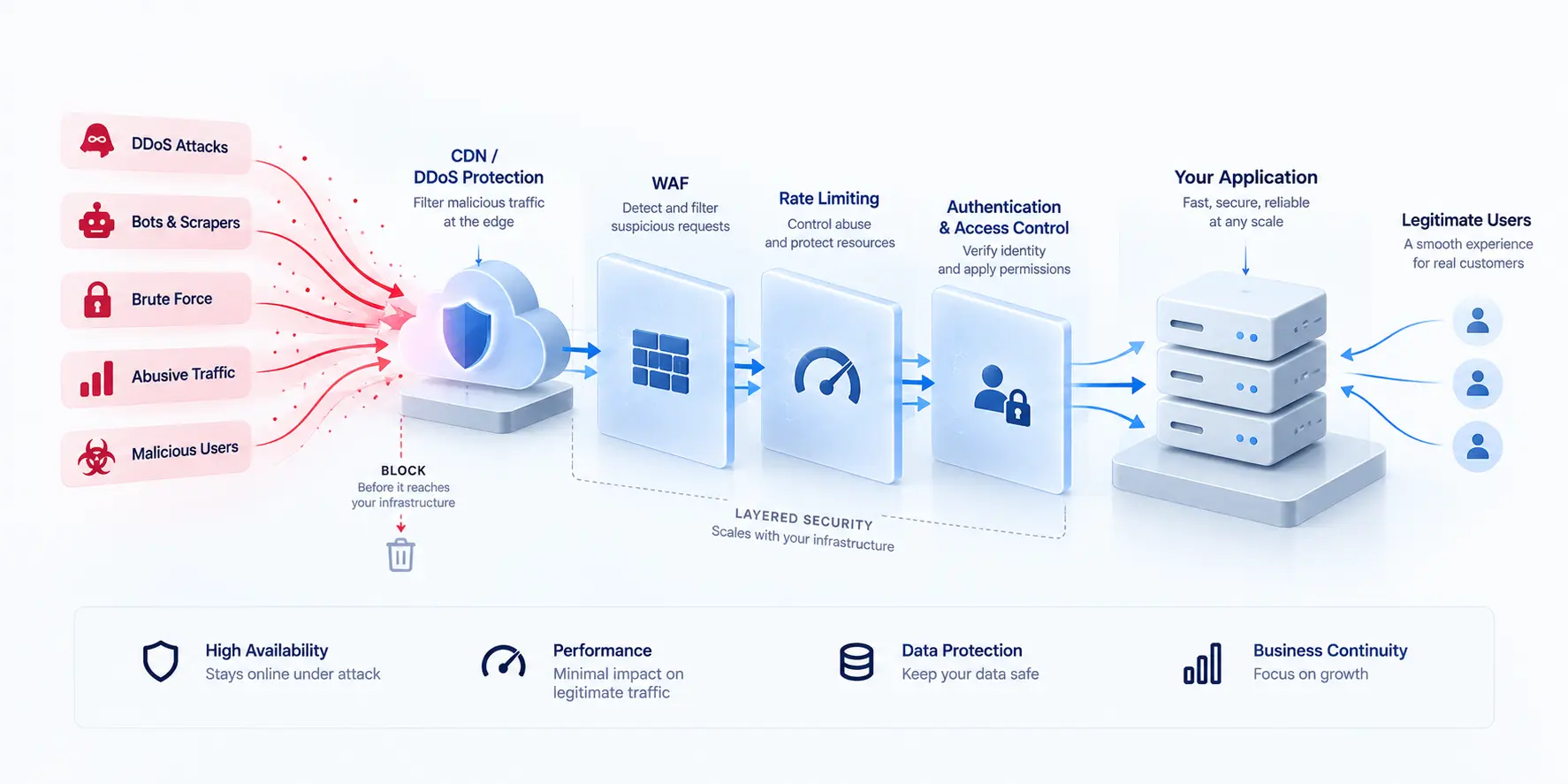
Effective DDoS protection therefore usually involves several defensive layers rather than one application-level mechanism.
Network-level protection
Volumetric attacks attempt to consume available network bandwidth with enormous quantities of traffic. These attacks are difficult to mitigate from inside the application because the network can become saturated before the application has an opportunity to inspect individual requests.
Cloud and edge infrastructure can absorb or filter this traffic before it reaches the origin environment. CDN and DDoS mitigation networks distribute traffic across large edge networks, while upstream filtering identifies known attack patterns and abnormal traffic.
For globally distributed applications, this makes the edge an important security boundary.
Traffic that can be rejected at the edge should generally not be allowed to consume origin capacity.
Protocol-level attacks
Not every denial-of-service attack relies purely on bandwidth. Attackers can target connection handling, transport protocols, or infrastructure components in ways that consume server resources with comparatively less traffic.
Load balancers, managed network infrastructure, connection limits, and cloud-native DDoS protection services therefore form another defensive layer between the public internet and application instances.
The architecture should be designed so that individual application nodes are not directly exposed when that exposure is unnecessary.
Application-layer DDoS attacks
Layer 7 attacks are more difficult because malicious requests may resemble legitimate application traffic.
A request to search a product catalog, generate a report, authenticate a user, calculate recommendations, or query a complex dataset may be syntactically valid while still being abusive when repeated at scale.
An attacker may deliberately target endpoints that are expensive to process. A relatively modest number of requests can create disproportionate backend work if each request triggers multiple database queries, external API calls, or computationally expensive operations.
This is where DDoS protection overlaps with rate limiting, caching, request validation, circuit breakers, and application-level resource isolation.
A resilient security architecture should therefore consider not only how many requests arrive, but how expensive those requests are to process.
If traffic spikes can reach your application infrastructure without meaningful controls, scaling alone may increase the resources for attackers.
Check how we can helpRate Limiting Controls Who Can Consume Capacity
Rate limiting defines how frequently a client is allowed to perform a particular operation within a given period.
The concept appears simple, but implementation becomes significantly more complicated in distributed systems.
A single application instance can maintain an in-memory counter and reject requests after a threshold is reached. Once traffic is distributed across dozens or hundreds of instances, that local counter no longer represents the client's actual request rate. A user could send requests through different instances and effectively multiply the intended limit.
High-load rate limiting therefore needs a strategy that remains consistent enough across distributed infrastructure without introducing a centralized bottleneck.
Rate limiting should happen at multiple layers
Not every limit belongs in the same place.
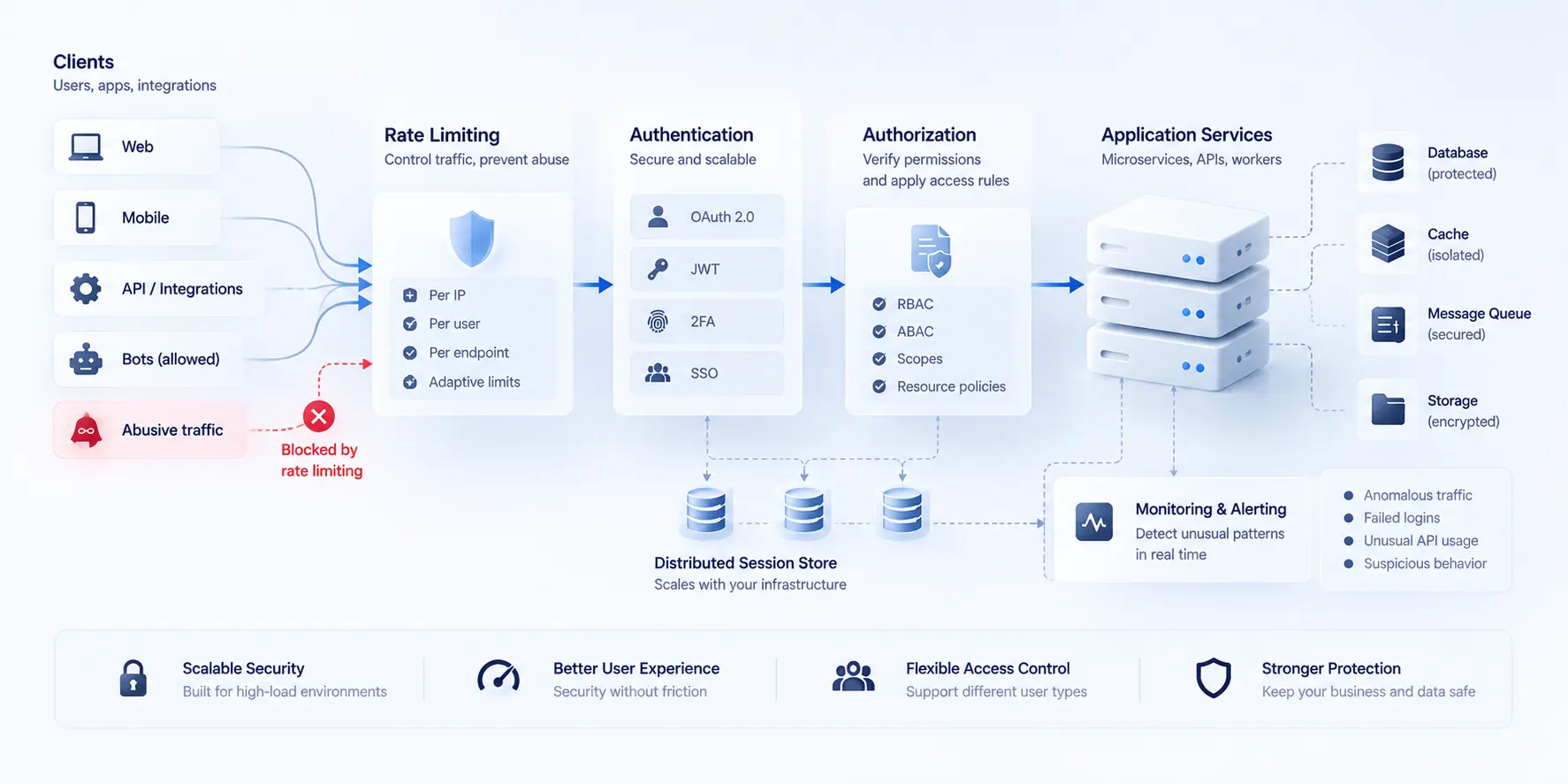
An edge or API gateway can enforce broad limits before traffic reaches application infrastructure. Application-level controls can then apply rules that require business context, such as limits associated with a particular user, organization, subscription plan, API key, or operation.
This layered approach reduces unnecessary backend work while preserving the ability to enforce more sophisticated policies deeper in the application.
For example, an anonymous endpoint might have a relatively strict IP-based limit at the edge, while an authenticated API applies additional limits based on account identity and subscription tier.
Fixed window
A fixed-window limiter divides time into predefined intervals. A client might be allowed 1,000 requests per minute, with the counter resetting at the beginning of every new minute.
The method is simple and efficient, but it can permit bursts around window boundaries. A client could send most of one minute's allowance immediately before the boundary and another full allowance immediately afterward.
For some APIs this is acceptable. For sensitive or resource-intensive operations, more precise algorithms may be preferable.
Sliding window
Sliding-window approaches calculate usage across a moving time interval rather than a fixed calendar boundary.
This produces smoother enforcement but usually requires additional state and computation. At large scale, that trade-off matters because the rate-limiting system itself may process enormous request volumes.
Token bucket
The token bucket algorithm is particularly useful when legitimate clients need occasional bursts.
Tokens accumulate at a defined rate up to a maximum capacity. Each request consumes a token. When no tokens remain, additional requests are delayed or rejected until capacity becomes available again.
This allows short bursts while still controlling average request volume over time.
Rate limits should reflect the cost of an operation
One of the most common mistakes is applying the same limit to every endpoint.
A cached GET request may consume almost no origin resources, while a complex report generation endpoint may perform significant database and compute work. Allowing both operations at the same request rate does not provide equivalent protection.
High-load systems can therefore benefit from weighted or operation-specific limits.
Authentication attempts, search, file uploads, AI inference, exports, payment operations, and computationally expensive API calls may all require different policies.
The objective is not merely to limit traffic. It is to control resource consumption.
Distributed Rate Limiting Creates a State Problem
Once an application runs across multiple instances or regions, rate limiting becomes another distributed systems problem.
The system needs enough shared information to determine how much capacity a client has already consumed.
Redis is frequently used for this purpose because counters can be updated quickly and shared across application instances. Atomic operations and expiration mechanisms make it possible to implement common rate-limiting algorithms without maintaining independent counters on every application server.
However, centralizing every rate-limit decision in one datastore introduces its own architectural considerations. The limiter has to handle very high throughput, remain available, and avoid becoming a latency bottleneck.
Large systems may therefore combine edge-level distributed controls with more specific application-level limits, partition state, or accept limited consistency where exact global enforcement is unnecessary.
The same principle that applies elsewhere in high-load engineering applies here as well: a mechanism introduced to protect the system should not become its next single point of failure.
What Should Happen When the Limit Is Reached?
A rate limiter also needs predictable client behavior.
For HTTP APIs, excessive requests are typically rejected with status code 429 Too Many Requests. Where appropriate, the response can indicate when the client should attempt another request.
Well-behaved clients should respond with controlled backoff rather than immediately retrying.
This matters because poorly designed retry logic can transform a temporary rate limit into additional load. Thousands of clients that retry simultaneously can create another traffic spike immediately after capacity becomes available.
Retry behavior therefore belongs to the broader resilience strategy.
Authentication Can Become a High-Load Bottleneck
Authentication is often treated primarily as a security feature, but at scale it is also a performance-sensitive distributed service.
Every login, token refresh, session validation, password reset, authorization check, and service-to-service identity operation consumes resources. During peak traffic, authentication infrastructure may process an enormous number of operations even when the underlying business functionality remains relatively stable.
An architecture where every API request performs an expensive database lookup for session validation can therefore create a bottleneck long before application servers reach their own capacity limits.
Stateless tokens reduce some centralized dependencies
Signed access tokens can allow services to validate identity locally without querying a central authentication database on every request.
The service verifies the token's signature and claims and can make an authorization decision without another network round trip.
This reduces pressure on centralized session infrastructure and can improve horizontal scalability.
However, stateless authentication introduces different trade-offs. Token revocation becomes more complicated, token lifetime needs careful design, signing keys need secure rotation, and sensitive information should not simply be placed into token payloads because the token is signed.
Stateless should not be confused with risk-free.
Short-lived access tokens limit exposure
Long-lived credentials increase the consequences of credential theft.
A common architecture therefore uses relatively short-lived access tokens together with a controlled refresh mechanism. The access token can be validated efficiently across distributed services, while refresh operations remain more tightly controlled by the authentication infrastructure.
This separates the high-frequency validation path from the more security-sensitive process of issuing new credentials.
Authentication endpoints need their own protection
Login endpoints are particularly attractive targets because they combine security sensitivity with computational work.
Password hashing is deliberately expensive. This is desirable because it makes offline password cracking more difficult, but it also means login attempts can consume significant CPU resources.
Credential stuffing attacks can exploit this asymmetry by generating large numbers of authentication attempts using previously compromised username and password combinations.
Authentication therefore needs dedicated rate limits, suspicious-activity detection, account protections, and potentially additional verification mechanisms when behavior becomes abnormal.
The system must balance abuse prevention against another security risk: allowing an attacker to intentionally lock legitimate users out of their accounts.
Rate limiting should therefore consider multiple dimensions rather than blindly blocking an account after a fixed number of requests.
Authorization Must Scale Too
Authentication answers who the user is. Authorization determines what that identity is allowed to do.
As systems move toward microservices and distributed architectures, authorization logic can become fragmented across services. If every service implements permissions differently, security becomes increasingly difficult to reason about and audit.
At the same time, forcing every request through one centralized authorization service may introduce latency and another critical dependency.
The architecture therefore needs a deliberate balance between centralized policy management and efficient local enforcement.
Roles, scopes, claims, resource ownership, tenant boundaries, and policy decisions should remain consistent across services even when enforcement is distributed.
This becomes especially important in multi-tenant systems where authorization failures can expose data belonging to another organization rather than merely another user.
Authentication and authorization should scale with application traffic without becoming a performance bottleneck or a single point of failure.
Contact expertsProtecting Data Becomes More Difficult as Systems Spread
Data protection is relatively easy to conceptualize when an application has one database and one backend.
High-load systems rarely remain that simple.
Data may exist in primary databases, read replicas, caches, search indexes, object storage, analytics platforms, queues, backups, logs, observability systems, and third-party integrations. Microservices may each own separate datastores, while asynchronous pipelines continuously move information between components.
The number of copies and processing locations therefore grows together with the architecture.
Security needs to follow the data.
Encryption in transit
Communication between users and the application should use encrypted transport, but encryption should not necessarily stop at the public edge.
Service-to-service traffic, database connections, internal APIs, administrative interfaces, and connections between distributed infrastructure components can also contain sensitive information.
A private network is not automatically a trusted network.
As architectures become more distributed, encrypting internal communication reduces the consequences of network interception and helps establish clearer trust boundaries.
Encryption at rest
Databases, object storage, disks, backups, and snapshots may all contain sensitive information.
Encryption at rest provides another layer of protection if storage media, snapshots, backups, or infrastructure access is compromised.
The cryptographic implementation is only part of the problem. Key management determines who can decrypt the data and under what conditions.
Keys therefore need their own access controls, rotation policies, auditability, and separation from the data they protect.
Secrets do not belong in application code
Database passwords, API keys, encryption keys, service credentials, and tokens should not be hardcoded into source repositories or baked permanently into application images.
Distributed systems often have many services requiring different credentials, which makes manual secret management increasingly dangerous as the architecture grows.
Centralized secret-management systems can provide controlled access, rotation, and auditing while allowing workloads to retrieve credentials at runtime according to their identity and permissions.
The goal should be to minimize both the number of long-lived secrets and the number of components that can access each secret.
Least Privilege Becomes More Important at Scale
Large systems contain more identities than just users.
Application services, CI/CD pipelines, background workers, serverless functions, containers, administrators, monitoring systems, and third-party integrations may all need access to infrastructure or data.
If every internal service receives broad permissions because it operates "inside" the platform, a compromise of one service can become a compromise of the entire environment.
Least privilege limits each identity to the permissions necessary for its function.
A worker that reads messages from one queue should not automatically receive administrative access to every queue. A service reading from one storage bucket should not necessarily be able to delete every object. An analytics component may need read access to specific datasets without permission to modify production records.
The more distributed the architecture becomes, the more important these boundaries become for controlling blast radius.
Caches Need the Same Security Attention as Databases
Caching is fundamental to high-load architecture because it reduces repeated computation and database traffic.
However, caches can contain the same sensitive information as the underlying database.
A Redis instance containing sessions, user profiles, authorization state, or cached API responses should therefore not be treated as disposable infrastructure from a security perspective.
Network access, authentication, encryption where appropriate, TTL policies, and restrictions on administrative operations all matter.
Cache keys themselves can also become a security concern. If cache isolation does not correctly include tenant or authorization context, one user may receive data generated for another.
This is a particularly dangerous class of high-load bug because caching can distribute the incorrect response at enormous scale.
Performance optimization should never bypass authorization boundaries.
Logs Can Accidentally Become a Data Leak
High-load systems generate large quantities of telemetry.
Logs may include request parameters, headers, error messages, user identifiers, IP addresses, database queries, stack traces, and contextual metadata. If logging is implemented without explicit data-handling rules, sensitive information can be copied from protected production systems into observability platforms with much broader access.
Passwords, authentication tokens, payment information, private API keys, and other secrets should never appear in logs.
Personally identifiable information should also be logged only where there is a defined operational need and appropriate retention and access controls.
This becomes a cost issue as well as a security issue. At high traffic volumes, verbose logs can produce enormous ingestion and storage costs.
Security, observability, and infrastructure efficiency therefore intersect again.
Security Controls Must Fail Safely
Security infrastructure itself can fail.
A rate-limit datastore may become unavailable. An authorization service may time out. A secret-management system may experience an outage. A WAF configuration may be deployed incorrectly. Token validation infrastructure may temporarily lose access to updated signing keys.
Each security dependency therefore needs an explicit failure policy.
Should the system fail open and allow requests when the security check is unavailable, or fail closed and reject them?
There is no universal answer.
For a public content endpoint, temporarily bypassing a non-critical abuse control may be preferable to a full outage. For an administrative operation, payment action, or access to sensitive data, allowing the request without successful authorization may be unacceptable.
These decisions should be made before the dependency fails.
This is where security architecture intersects directly with graceful degradation and fault tolerance.
A system cannot be considered resilient if its security layer disappears under load. It also cannot be considered secure if its fallback behavior silently removes critical controls.
Autoscaling Is Not a DDoS Strategy
One particularly dangerous assumption in cloud architecture is that autoscaling automatically protects against denial-of-service attacks.
Autoscaling protects availability by adding resources as demand grows. During legitimate traffic spikes, this is exactly what the system should do.
During an attack, however, unlimited scaling may simply convert malicious traffic into a larger infrastructure bill.
An attacker sends more requests, autoscaling creates more instances, those instances process more attack traffic, and the platform continues adding resources.
The system may technically remain online while generating enormous compute, bandwidth, database, and third-party service costs.
Scaling therefore needs to work alongside filtering, rate limiting, quotas, budget controls, anomaly detection, and resource ceilings.
The objective is not to provision enough infrastructure to process every request an attacker can generate. It is to prevent illegitimate work from consuming expensive resources in the first place.
Monitoring Security Under High Load
Security monitoring needs to understand normal system behavior before it can reliably identify abnormal behavior.
A sudden increase in requests is not necessarily an attack. A new product launch, marketing campaign, crawler, partner integration, or legitimate customer can produce unusual traffic.
This is why security signals should be correlated with operational telemetry.
Useful indicators may include changes in requests per second, unusual geographic distribution, sudden increases in authentication failures, abnormal API-key usage, increased 429 responses, cache-bypass patterns, repeated access to expensive endpoints, unexpected data-transfer growth, unusual token refresh activity, and changes in infrastructure utilization.
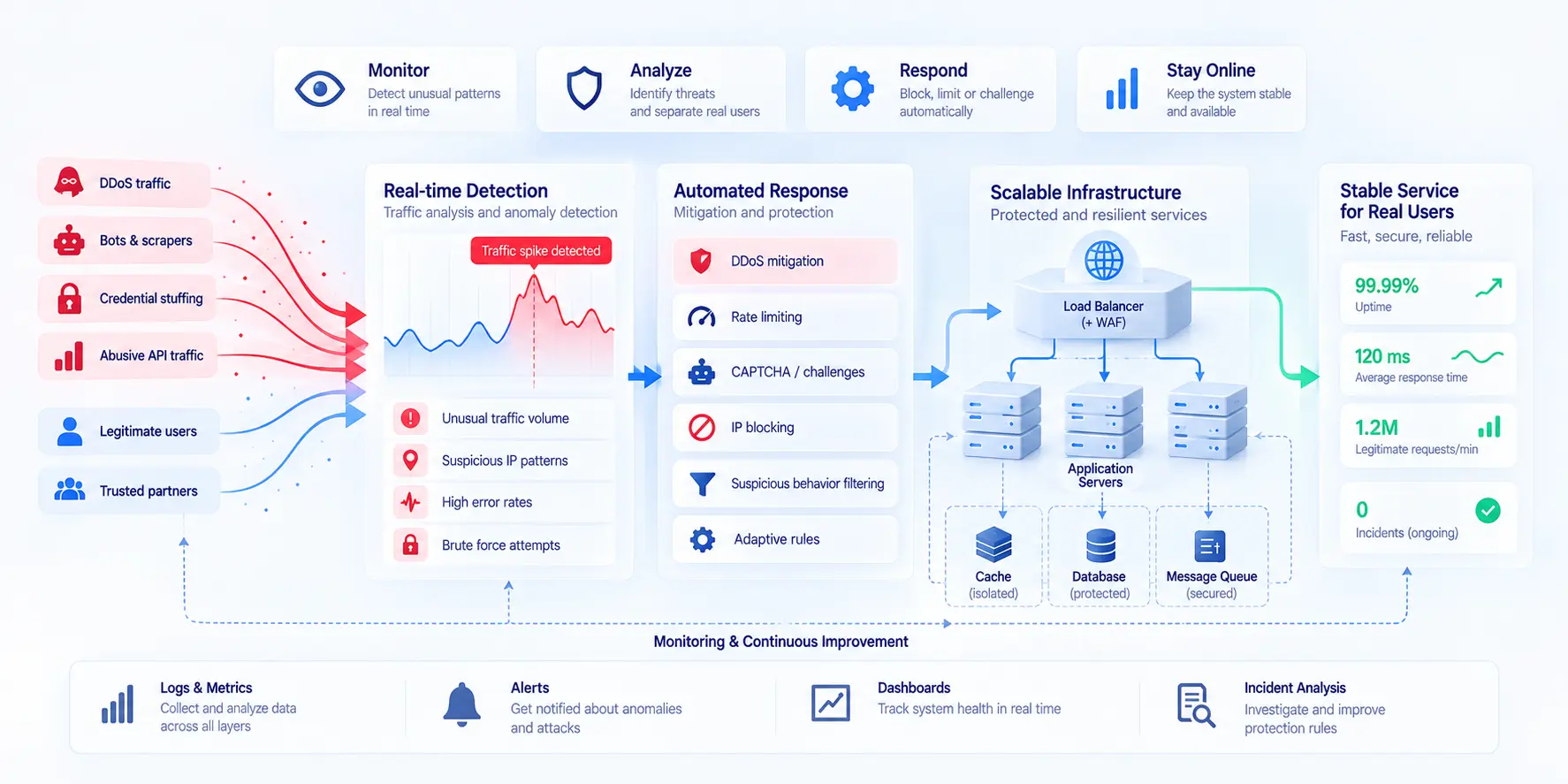
Alerts should identify conditions that require investigation rather than every individual rejected request.
At high scale, an alert for every security event becomes unusable almost immediately.
Teams need aggregation, thresholds, anomaly detection, dashboards, and incident context that make it possible to distinguish routine background abuse from events that threaten availability or data.
Designing Security Into a High-Load Architecture
Security is most effective when it is designed into the request path rather than attached after the system has already scaled.
A practical architecture begins at the edge. CDN infrastructure, DDoS protection, WAF rules, and broad traffic controls should filter obvious abuse before it reaches application infrastructure.
API gateways and rate limiters then enforce request policies appropriate to endpoints, clients, identities, and business operations.
Authentication validates identity without requiring unnecessarily expensive centralized operations on every request. Authorization ensures that authenticated identities can access only the resources and actions they are permitted to use.
Application services validate input, enforce business rules, and isolate expensive operations so that abuse of one feature does not exhaust resources needed by the rest of the platform.
Data remains encrypted in transit and at rest where appropriate, while secrets and cryptographic keys are managed independently from application code.
Monitoring connects these layers by identifying unusual behavior and showing whether security mechanisms are themselves approaching their limits.
The result is not one security product. It is a sequence of controls that progressively reduces risk as traffic moves deeper into the architecture.
High-load security works best when protection, scalability, and resilience are designed as one architecture rather than three separate concerns.
Learn moreSecurity Testing Should Include Load
A security mechanism that works correctly with 100 requests per second may behave very differently with 100,000.
Rate-limit stores can become saturated. Authentication services can exhaust connection pools. WAF rules can introduce unexpected latency. Logging can generate excessive I/O. Encryption and cryptographic verification consume CPU. External identity providers may enforce their own quotas.
Security testing should therefore include performance and load scenarios rather than evaluating controls only for functional correctness.
Teams should test how the system behaves when rate limits are reached, authentication traffic spikes, malicious requests target expensive endpoints, a security dependency becomes unavailable, and defensive rules reject a significant percentage of incoming traffic.
The objective is to confirm that security mechanisms protect the system under the conditions where they are needed most.
Security and Performance Are Not Opposites
Security controls inevitably consume some resources.
Token verification requires computation. Encryption requires CPU. WAF inspection adds processing. Rate limiting requires state. Logging and audit trails consume storage and network capacity.
The wrong conclusion is that these controls should be weakened to improve performance.
The better engineering question is how to make them scalable.
Authentication can avoid unnecessary database calls. Rate limiting can be distributed efficiently. Encryption can use modern hardware acceleration. Security filtering can happen closer to the edge. Logs can be structured and sampled according to their operational value. Authorization policies can be designed for efficient evaluation.
In a well-designed high-load system, security is not a layer that fights against scalability. It is part of the scalability model because uncontrolled traffic, compromised accounts, excessive permissions, and exposed data can all become availability problems at sufficient scale.
Conclusion
High-load security is not simply conventional application security applied to larger servers. Scale changes both the attack surface and the consequences of architectural decisions.
DDoS attacks target finite network and infrastructure capacity. Application-layer abuse targets expensive operations rather than bandwidth alone. Rate limiting determines which clients are allowed to consume shared resources and how quickly. Authentication and authorization need to remain secure while operating across distributed infrastructure. Data protection becomes more complicated as information moves through databases, replicas, caches, queues, logs, backups, and multiple services.
These concerns cannot be solved independently.
DDoS filtering without application-level limits may still allow expensive legitimate-looking requests to overwhelm backend systems. Rate limiting without scalable state management can become a bottleneck. Stateless authentication can improve scalability while creating new token-management requirements. Encryption protects data, but excessive permissions can still expose it. Autoscaling improves capacity, but without traffic controls it can also scale the cost of an attack.
The objective is therefore to build an architecture where security controls scale with the product and where malicious or abnormal traffic is rejected before it can consume the resources reserved for legitimate users.
A high-load system is not truly scalable if it can process enormous traffic only when every request behaves exactly as expected. Real scalability includes the ability to distinguish useful work from harmful work, contain abuse, protect data, and keep critical services available even when traffic becomes hostile.