
Step-by-Step: How to Build a Scalable High Load System from Scratch
A scalable high-load system rarely starts as a large distributed architecture.
Most successful products begin with a relatively simple application, a database, and enough infrastructure to support their current users. Complexity appears gradually as traffic increases, concurrent activity grows, data accumulates, and particular components reach their practical limits.
The challenge is deciding what to change, when to change it, and how to prove that each change actually increases capacity.
Building every possible scaling mechanism into an MVP creates unnecessary engineering and operational overhead. Waiting until users experience timeouts, failed transactions, or outages creates a different kind of cost. A practical high-load roadmap sits between these extremes: build the simplest architecture that satisfies current requirements, make its behavior measurable, identify its next constraint, and evolve the system before that constraint becomes a business problem.
This guide takes that approach from the first architecture decisions through load testing, database optimization, caching, asynchronous processing, horizontal scaling, fault tolerance, observability, and continuous capacity planning.
Step 1: Define What "High Load" Means for Your Product
Start with workload requirements.
"Millions of users" provides very little architectural information by itself. One million registered accounts can generate modest infrastructure demand if only a small percentage are active. A much smaller platform can create substantial pressure if thousands of users perform database-intensive operations simultaneously.
The useful questions are more specific:
How many requests per second should the system support?
How many users may be active concurrently?
What are the expected read and write volumes?
Which operations are computationally expensive?
How quickly is the dataset expected to grow?
Are there predictable peaks such as campaigns, product launches, sporting events, or billing periods?
Which workflows generate revenue or carry operational risk?
What latency is acceptable for those workflows?
How much downtime can the business tolerate?
These requirements create the first capacity model.
For example, an ecommerce system may have moderate daily traffic and experience a 20x increase during a campaign. A B2B SaaS platform may have predictable traffic while storing billions of records. A messaging product may care primarily about concurrent connections and event throughput. A payment platform may prioritize transaction correctness and availability alongside throughput.
Each workload creates a different scaling path.
Our guide to what a high load system is and when a product actually needs one explores these triggers in greater detail. For a new system, the important first step is converting expected growth into measurable technical requirements.
Define the first performance targets
Before architecture decisions become complex, establish several initial targets:
Area | Example target |
|---|---|
Peak traffic | Expected requests or operations per second |
Concurrency | Simultaneously active users or connections |
Latency | p95/p99 response-time target |
Availability | Required service availability |
Data growth | Expected storage growth per month/year |
Recovery | Acceptable recovery time and data loss |
Cost | Infrastructure budget at expected traffic |
The exact numbers depend on the product. Their purpose is to give engineering decisions a measurable reference point.
Step 2: Start With the Simplest Architecture That Can Evolve
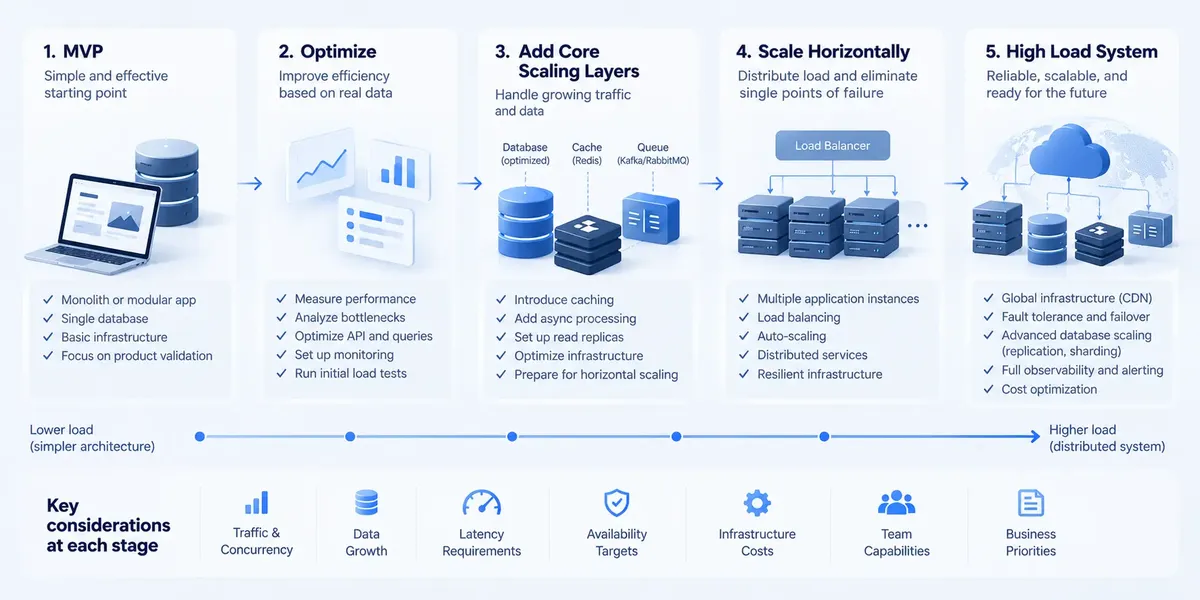
For many new products, a well-structured monolith is a reasonable starting architecture.
It reduces deployment complexity, keeps local development straightforward, simplifies debugging, and allows a small engineering team to change the product quickly. The architecture can still be designed around clear module boundaries so that components can be separated later when scaling requirements justify the change.
The more important early decision is understanding where state lives.
Application instances become easier to replicate when sessions and persistent data are stored outside individual application processes. Databases, distributed caches, object storage, and other dedicated stateful components can provide that persistence while application services remain replaceable.
This creates a useful foundation for future horizontal scaling.
The complete architectural reasoning behind monoliths, microservices, stateless services, distributed systems, event-driven communication, and single points of failure is covered in our high-load architecture guide.
At this stage, aim for clear boundaries and predictable behavior:
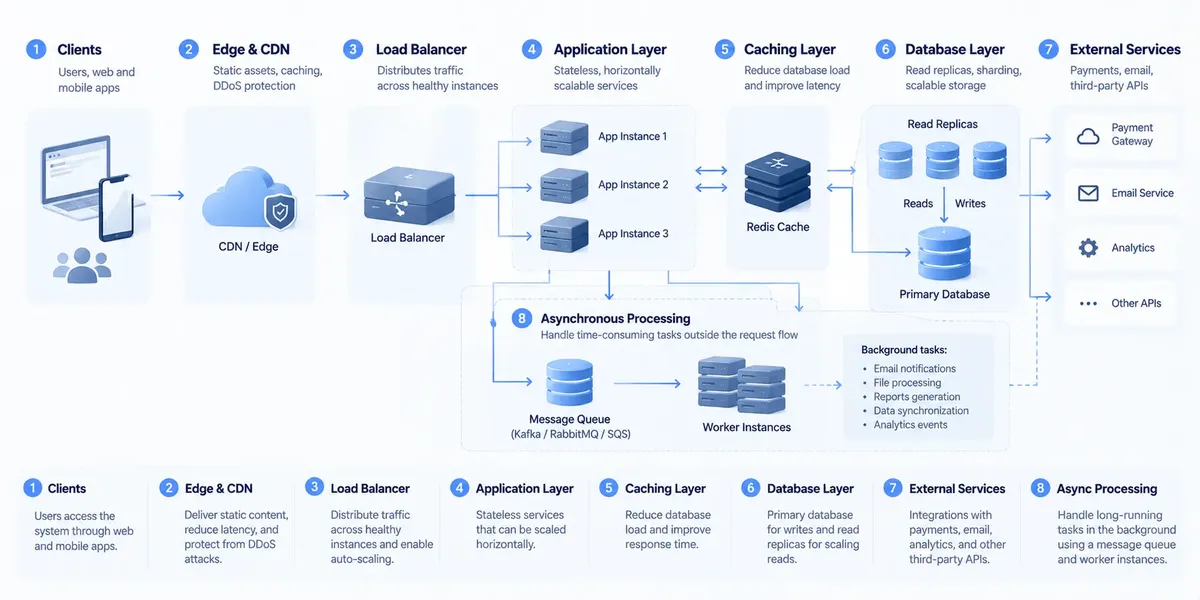
Client -> CDN / edge -> load balancer -> application -> database
Additional layers should have a reason to exist.
A queue needs a workload that benefits from asynchronous processing. Redis needs a repeatable caching use case. Database replicas need read pressure or availability requirements. Microservices need independent scaling, deployment, ownership, or isolation requirements.
This incremental approach keeps the architecture understandable while preserving room for growth.
Build for growth before traffic becomes a bottleneck.
Build for scaleStep 3: Design the Request Path Before Scaling Infrastructure
Once the basic architecture is established, examine what happens during a typical request.
A user request may trigger application logic, multiple database queries, calls to external services, data transformations, logging, notifications, file processing, analytics events, or other operations.
Under low traffic, inefficient request paths can remain hidden. At higher concurrency, every unnecessary operation is multiplied.
A request that performs ten avoidable database queries becomes 10,000 queries when 1,000 similar requests arrive within the same period.
This makes API and backend design one of the earliest scaling opportunities.
Keep response payloads controlled through pagination and filtering. Set explicit timeouts for dependencies. Use idempotency where repeated requests can create duplicate transactions. Separate expensive work from operations that genuinely need to finish before the user receives a response.
Our guide to building a high load backend covers API design, rate limiting, asynchronous processing, Kafka, RabbitMQ, and load distribution in detail.
At this stage, the architectural objective is a request path whose cost is understood.
Step 4: Establish Observability Before Serious Optimization
A scalable system needs measurable behavior.
Without telemetry, teams can see that the product feels slow while having limited evidence about the actual constraint. Additional servers may be deployed while the real bottleneck remains an inefficient query. A database may be upgraded while latency originates in an external API. Redis may be introduced while application CPU remains the dominant constraint.
Instrument the system early enough to establish a baseline.
At minimum, track traffic, latency, errors, and saturation. For latency, p50, p95, and p99 provide much more useful information than a single average.
Infrastructure telemetry should include CPU, memory, disk, network, and relevant container metrics. Application telemetry should include endpoint latency, errors, timeouts, retries, dependency calls, and important business operations.
Database telemetry may include query latency, connection pool utilization, locks, slow queries, read/write throughput, storage growth, and replication lag once replicas exist.
Queues require visibility into producer rate, consumer throughput, queue depth, message age, retries, and dead-letter traffic.
The complete observability stack can grow with the system. Metrics, structured logs, and distributed traces eventually provide complementary views of production behavior.
Our guide to monitoring high load systems explains this layer in depth.
The practical outcome of this step is a baseline:
At current traffic, what consumes capacity, where does latency accumulate, and which resource reaches its limit first?
That answer determines the next investment.
Step 5: Load Test the Architecture Before Users Do It for You
Production traffic should never be the first serious capacity test.
A useful load test models the behavior the application is expected to encounter. That can include gradual ramp-up, sustained traffic, sudden spikes, large numbers of concurrent sessions, database-heavy operations, background jobs, or specific business events.
The test should reproduce the important traffic mix as closely as practical.
A checkout platform gains little from a test that repeatedly requests its homepage while the real scaling risk lives in inventory reservation, payment processing, and order creation.
Run tests against an environment representative of production and observe the complete system during the test.
Measure:
throughput;
p50, p95, and p99 latency;
error rate;
CPU and memory;
database latency and connections;
cache behavior;
queue growth;
dependency latency;
infrastructure saturation.
Then continue increasing demand until a meaningful limit appears.
The first objective is to discover the current capacity envelope. The second is to identify the component responsible for the limit.
A useful result sounds like this:
At 2,800 requests per second, p99 API latency exceeds the target because database connection utilization reaches its practical limit.
That statement gives the engineering team something concrete to improve.
After the change, repeat the same test.
Scaling becomes an iterative engineering process:
Baseline -> Load test -> Find bottleneck -> Improve -> Retest -> Compare
Step 6: Optimize the Database Before Distributing It
The database frequently becomes one of the first structural constraints in a growing application.
Begin with the access patterns already visible in production and load tests.
Inspect expensive queries. Review execution plans. Add appropriate indexes. Remove unnecessary queries. Reduce excessive data retrieval. Examine connection pooling, transactions, locks, and long-running operations.
These improvements can increase capacity substantially while preserving a relatively simple architecture.
When read volume becomes the dominant pressure, caching and read replicas become possible next steps. Replicas distribute read workloads and can also contribute to availability, although replication introduces synchronization and consistency considerations.
As the dataset grows, partitioning may improve manageability and query behavior.
Sharding belongs later in the evolution for many systems because it changes how data is distributed across independent database instances. Query routing, cross-shard operations, rebalancing, shard-key selection, transactions, and operational procedures all become more complex.
Our database scaling guide examines replication, partitioning, sharding, caching, CQRS, availability, and consistency in greater depth.
A useful progression for many products looks like this:
Query optimization -> Indexing -> Connection optimization -> Caching -> Read replicas -> Partitioning -> Sharding
Actual workloads can produce a different order. Telemetry determines which step provides value.
Step 7: Add Caching Where Repeated Work Creates Pressure
Caching can increase system capacity without immediately increasing database or application infrastructure.
Start with workloads where the same data or computation is requested repeatedly and where an acceptable freshness policy can be defined.
Redis can reduce repeated database access for frequently requested application data. A CDN can serve static and cacheable content closer to users while reducing requests reaching the origin. Local application caches can help with small, frequently accessed datasets when their consistency requirements are understood.
Every cache also requires a freshness strategy.
Define:
what is cached;
the cache key;
TTL;
invalidation triggers;
acceptable staleness;
behavior during a cache miss;
behavior when the cache is unavailable;
protection against cache stampedes.
Our detailed guide to caching strategies for high-load systems covers cache-aside, read-through, write-through, write-around, write-back, Redis, CDN caching, and invalidation patterns.
Caching works particularly well when it targets a measured source of repeated work. Track cache hit ratio and downstream load after implementation to verify the effect.
Step 8: Move Expensive Work Out of the Synchronous Request Path
As the application grows, some operations will consume time without needing to complete before the user receives a response.
Examples include:
email delivery;
report generation;
image and video processing;
analytics ingestion;
search indexing;
webhook processing;
data synchronization;
certain order-processing steps;
batch operations.
These workloads can move to background processing.
A queue creates a buffer between the producer and the consumer. During a traffic spike, incoming work can accumulate while workers process it according to available capacity. Additional consumers can be introduced as demand grows.
RabbitMQ can fit task-oriented workflows and controlled message delivery. Kafka is commonly used for high-throughput event streams and data pipelines. Cloud-native queues such as SQS can provide another operational model.
The choice should follow workload requirements around throughput, ordering, retention, delivery semantics, replay, and operational complexity.
Async processing also introduces responsibilities around idempotency, retries, duplicate processing, dead-letter handling, queue monitoring, and backpressure.
A queue becomes a scaling mechanism when the complete workflow around it is engineered and observed.
Step 9: Scale the Application Horizontally When One Instance Becomes the Constraint
At earlier stages, vertical scaling can provide a fast and economical way to increase capacity. More CPU, memory, or faster storage may give the product substantial headroom without architectural changes.
Eventually, a single application instance may become an undesirable capacity or availability boundary.
This is where horizontal scaling becomes valuable.
Multiple application instances can run behind a load balancer, allowing traffic to be distributed across healthy nodes. Stateless application design makes this substantially easier because requests can reach any available instance.
Our comparison of vertical and horizontal scaling explains the cost, complexity, and operational trade-offs involved in that transition.
Autoscaling can then adjust capacity according to observed demand.
CPU and memory are common scaling signals, while many systems benefit from workload-specific metrics such as request rate, queue depth, active connections, or processing lag.
The key requirement is that additional instances actually increase useful capacity.
If ten application instances still depend on a saturated primary database, the database remains the limiting factor. If workers scale while an external API enforces a fixed rate limit, adding workers can increase contention.
Horizontal scaling works when the workload can be distributed and the dependencies behind it can support the additional demand.
Step 10: Scale the Frontend and Delivery Layer
A high-capacity backend can still produce a slow product.
As traffic and product complexity grow, frontend architecture becomes part of the scaling strategy. Large JavaScript bundles, expensive client-side rendering, oversized assets, third-party scripts, and distant origin servers can all degrade the experience even when backend APIs remain healthy.
Use CDN and edge delivery for cacheable assets. Optimize images and other media. Split JavaScript by route or feature where appropriate. Load secondary resources according to their actual priority. Choose SSR, CSR, static generation, or hybrid rendering according to the product's requirements.
Performance should be evaluated across the complete path:
User -> Edge/CDN -> Application -> Services -> Cache -> Database -> Response -> Browser -> Interaction
Our guide to frontend performance at scale covers rendering strategies, lazy loading, CDN delivery, asset optimization, resource prioritization, and frontend monitoring.
At this stage, backend throughput and frontend performance should be treated as parts of the same user experience.
Step 11: Design for Partial Failure
Greater scale creates more components and dependencies. Every dependency can eventually become slow, unavailable, overloaded, or inconsistent.
Build resilience around the workflows that matter most.
Remove critical single points of failure. Use multiple application instances and database redundancy where business requirements justify them. Implement meaningful health checks. Define failover behavior. Add explicit timeouts around remote calls.
Use retries selectively and control their frequency. Circuit breakers can stop repeated calls to a dependency that is already failing. Bulkheads and isolated resource pools can keep one overloaded workflow from consuming capacity required by unrelated parts of the application.
Graceful degradation can preserve critical workflows during incidents. An ecommerce platform may continue supporting product browsing and checkout while recommendations are temporarily unavailable. A system may serve safe cached information when an origin dependency becomes unavailable.
Our article on building fault-tolerant systems examines redundancy, failover, circuit breakers, graceful degradation, async resilience, and failure isolation.
Resilience mechanisms also need testing.
Terminate instances. Make dependencies unavailable. Exercise database failover. Inject latency. Stress queues. Run load while capacity is reduced.
The result you need is evidence that critical workflows remain within their defined reliability requirements during realistic failures.
Step 12: Treat Security as Part of Capacity Planning
Security controls also operate under load.
Authentication, authorization, encryption, WAF rules, rate limiting, bot protection, logging, and abuse detection consume resources and need to behave correctly during traffic spikes.
Rate limiting should protect expensive endpoints and prevent individual clients from consuming disproportionate capacity. Authentication infrastructure needs sufficient capacity for peak concurrency. DDoS protection should operate before malicious traffic reaches scarce application resources whenever possible.
Security testing should also consider legitimate high traffic and hostile traffic patterns because the infrastructure needs to distinguish between demand the business wants to serve and activity that should be constrained.
The architectural goal is predictable system behavior even when traffic contains a mixture of valid requests, abusive clients, bots, retries, and attack traffic.
Step 13: Introduce Cost Controls as the Architecture Becomes Elastic
Elastic infrastructure can scale quickly. Cloud spend can scale with it.
Track infrastructure cost alongside traffic and performance. Useful measurements include cost per request, cost per active user, database cost per workload, cache utilization, network egress, storage growth, idle capacity, and the relationship between autoscaling events and actual demand.
Architecture decisions directly influence these numbers.
Caching can reduce database and compute pressure. CDN delivery can reduce origin traffic. Efficient queries can postpone larger database instances. Autoscaling can reduce idle compute. Poor scaling thresholds can create unnecessary churn and expense.
The objective is sustainable capacity.
Performance and cost should be reviewed together because a technically scalable architecture still needs an economically sustainable operating model.
Step 14: Validate the Complete System Under Realistic Peak Conditions
Once the major scaling layers are in place, test them together.
A realistic test should exercise the same interactions that production traffic creates:
Users -> CDN -> Load balancer -> Application instances -> Cache -> Database / replicas -> Queues -> Workers -> External services
Observe how the system behaves as load increases.
Then introduce failure.
Remove an application instance. Restart workers. reduce database capacity. Delay an external dependency. Empty or invalidate caches. Exercise failover. Generate a burst that exceeds normal peak traffic.
Watch p95 and p99 latency, errors, saturation, queue lag, replication lag, cache hit ratio, resource utilization, autoscaling behavior, and business transaction success.
The test should answer three questions:
What load can the system sustain?
What component reaches its limit first?
What happens when a component fails near peak load?
Real platforms evolve through this same combination of workload distribution, caching, data partitioning, asynchronous processing, redundancy, and continuous optimization. Our analysis of Netflix, Uber, and Instagram examines how these patterns appear in systems operating at enormous scale.
Prepare your architecture for higher traffic and demand.
Discuss your project with our expertsA Practical High Load Development Roadmap
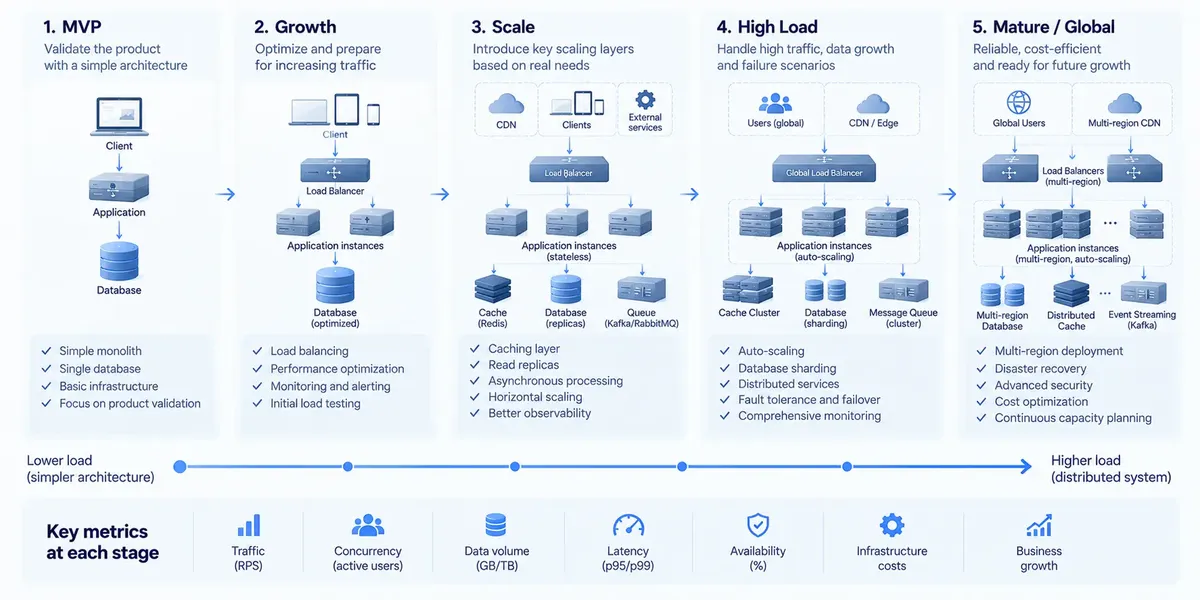
The entire process can be summarized as an evolutionary roadmap.
Stage | Main objective | Typical actions | Signal to move forward |
|---|---|---|---|
MVP | Validate the product | Simple architecture, structured monolith, primary database | Real usage begins growing |
Baseline | Understand behavior | Metrics, logs, latency percentiles, traffic measurements | Bottleneck becomes measurable |
Backend optimization | Increase efficiency | API optimization, pagination, rate limiting, query optimization | Resource or database pressure persists |
Data optimization | Increase data capacity | Indexing, connection tuning, caching, replicas | Dataset/write volume exceeds current model |
Async processing | Absorb expensive work | Queues, workers, events, retries | Synchronous workflows constrain throughput |
Horizontal scaling | Increase compute capacity | Stateless services, load balancing, autoscaling | Single-instance capacity becomes limiting |
Distributed data | Scale large datasets/workloads | Partitioning, sharding, workload separation | Primary data architecture reaches structural limits |
Resilience | Control failure | Redundancy, failover, circuit breakers, graceful degradation | Availability becomes business-critical |
Continuous optimization | Maintain efficiency | Observability, load testing, cost controls, capacity planning | Ongoing |
This sequence is intentionally flexible.
A media platform may need CDN and object storage very early. A financial product may require redundancy and strict security controls before it has substantial traffic. A data-intensive SaaS platform may encounter database scaling problems while application servers still have significant spare capacity.
The roadmap should follow the workload.
How Do You Know What to Scale Next?
Look for the component whose behavior deteriorates first as traffic increases.
If application CPU reaches its practical limit while downstream systems remain healthy, increase compute efficiency or application capacity.
If database latency and connection utilization rise while application instances remain underutilized, work on the data layer.
If repeated reads dominate database workload, introduce or improve caching.
If long-running operations occupy request resources, move suitable work to asynchronous processing.
If queue depth grows continuously, increase consumer capacity or optimize processing.
If static delivery creates origin pressure or geographic latency, improve CDN and edge caching.
If infrastructure remains healthy while users experience slow rendering, investigate frontend performance.
If the system has enough capacity while a single component failure causes an outage, prioritize resilience.
The next scaling decision should come from evidence produced by the system.
What Should You Build From Day One?
A product can remain relatively simple while still preserving a good scaling path.
Several foundations are valuable early:
clear application boundaries;
stateless application services where practical;
database indexes aligned with real access patterns;
pagination and bounded API responses;
timeouts for external dependencies;
idempotency for critical operations;
structured logs;
basic metrics and alerts;
automated deployment;
reproducible infrastructure;
backups and tested recovery procedures;
basic security controls;
an architecture that allows individual components to evolve.
These foundations reduce the cost of later scaling because they make system behavior easier to understand and components easier to change.
Advanced distributed architecture can then be introduced where production evidence justifies it.
The Core Scaling Loop
High-load development eventually becomes a continuous engineering loop:
Measure -> Test -> Identify the constraint -> Improve -> Validate -> Monitor -> Repeat
Traffic changes.
Datasets grow.
Features add new workloads.
External dependencies change.
Infrastructure prices change.
Usage patterns shift.
A system that comfortably handles today's traffic can develop a completely different bottleneck six months later.
This is why capacity planning should use historical telemetry and repeated load testing. Previous benchmark results describe a previous version of the product. New releases, database growth, dependencies, and user behavior can change the relationship between infrastructure and capacity.
A scalable system therefore evolves continuously around measurable constraints.
Build for the Next Constraint
A high-load system from scratch does not require every scaling technique on the first architecture diagram.
It requires a clear path from the current workload to the next one.
Start with measurable requirements. Keep the first architecture understandable. Instrument it. Load test it. Find the first bottleneck. Improve that bottleneck and measure the result. Introduce caching, queues, replicas, horizontal scaling, distributed data, and additional resilience as the workload creates a reason for each capability.
This approach keeps engineering effort aligned with actual growth while preserving the architectural flexibility required for larger scale.
Binerals follows the same progression in high-load engineering projects: architecture and bottleneck analysis, database optimization, caching, asynchronous processing, scalable infrastructure, load testing, and production observability.
If you are designing a new platform for substantial growth or want to validate whether the architecture can support the traffic you expect, our High-Load System Development team can review the architecture, identify likely capacity constraints, and build a practical scaling roadmap before those constraints reach production.
Build a System That Can Grow With Your Product
Discuss your high-load project